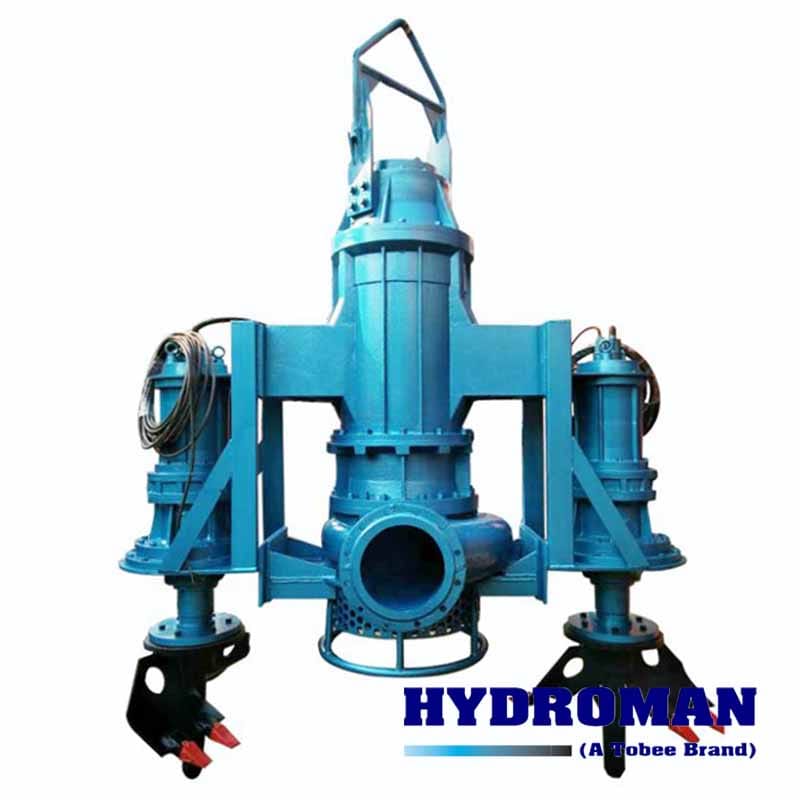
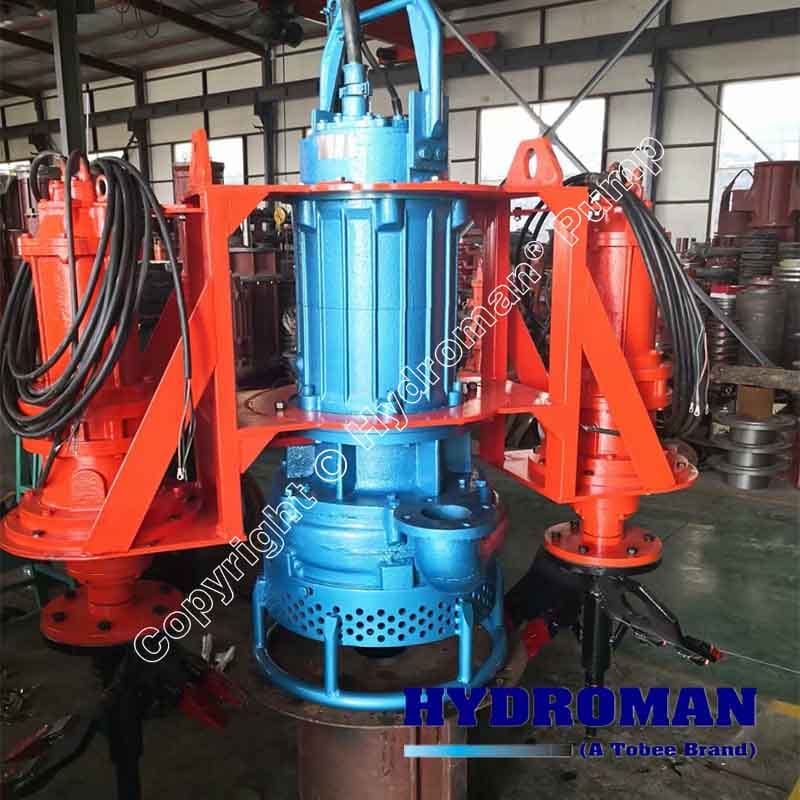
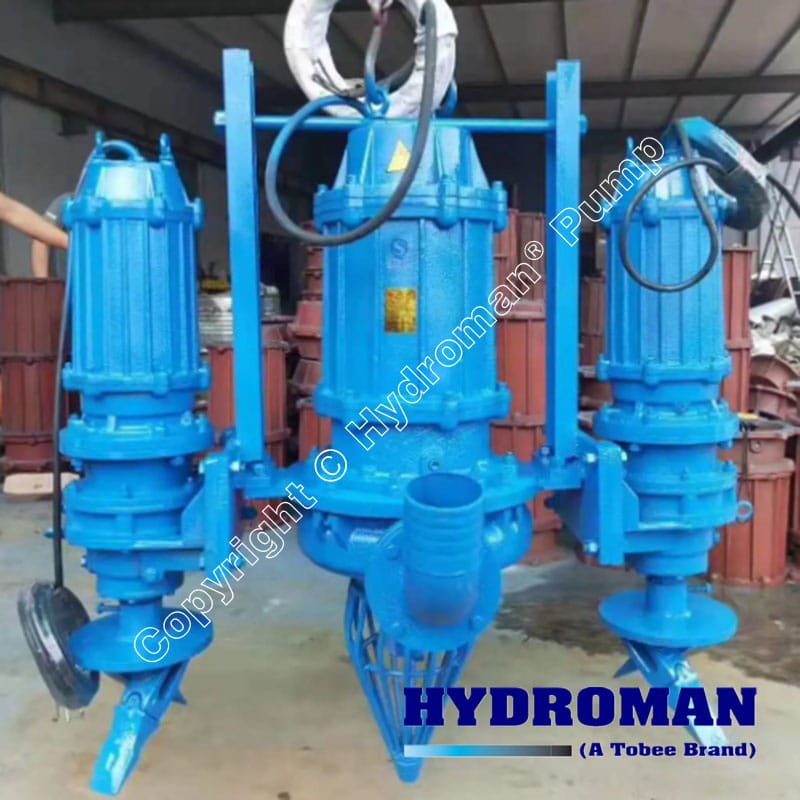
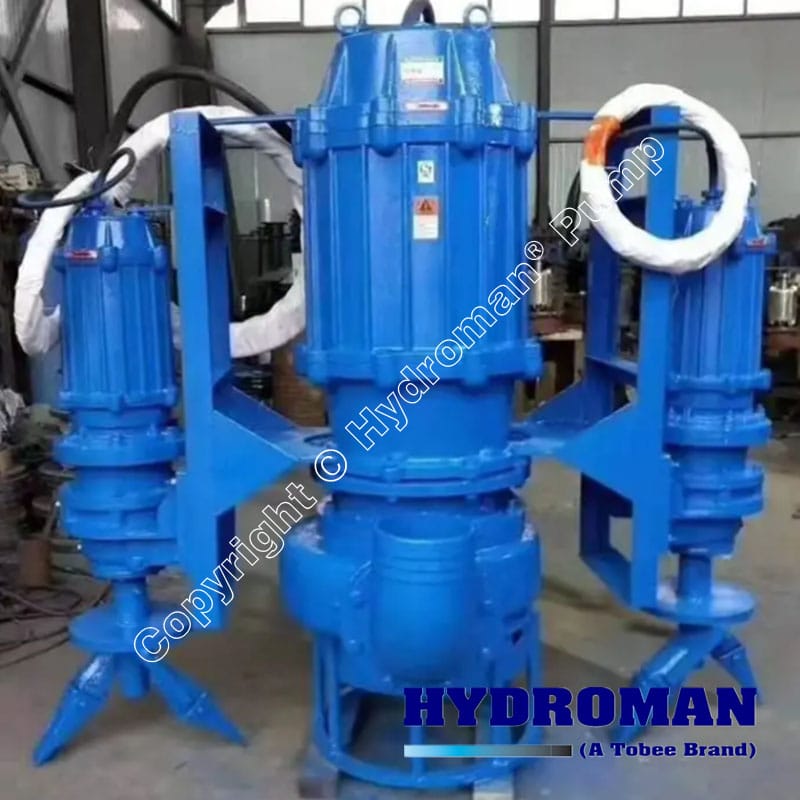

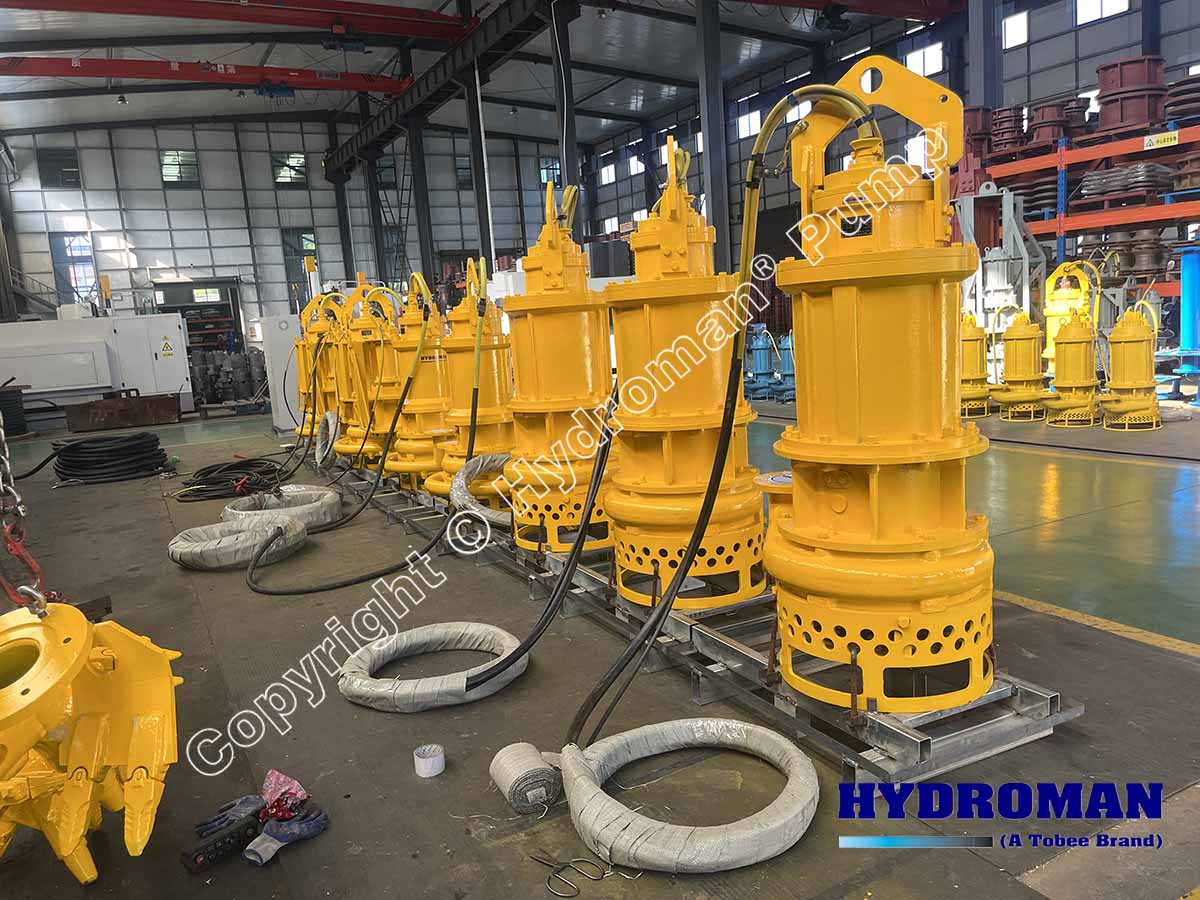
If you've ever watched a conventional centrifugal pump choke on heavy slurry and grind to a halt two weeks into a mining cycle, you already know why this category of pump exists. The Hydroman® Submersible Dredge Pump was engineered from the ground up for continuous, fully submerged operation in the harshest underwater environments — sand dredging, tailings transfer, sediment excavation, slurry removal ect.
This isn't a repurposed dewatering pump with an upgraded impeller. It's a purpose-built underwater slurry pump designed to sit directly inside the material it's moving, eliminating the suction limitations that cripple surface-mounted systems and opening the door to high flow rates and solids concentrations that most pumps simply can't sustain.
Whether you're running a sand dredging operation on a river delta, managing tailings ponds at a copper mine, or clearing decades of compacted sediment from a reservoir, the Hydroman® submersible dredge pump keeps working where others stop.
A submersible dredge pump operates fully underwater, submerged directly into the slurry rather than pulling material up from a distance. That distinction sounds simple, but it fundamentally changes what's possible in terms of solids handling, efficiency, and system longevity.
Traditional centrifugal slurry pumps rely on suction lift — the pump sits above the material and draws it upward. Every foot of suction head costs you efficiency, and once your slurry gets dense or your solids concentration climbs past a certain point, cavitation, clogging, and wear become constant operational realities. Industry data consistently shows that centrifugal pumps handling slurries above 35–40% solids by weight experience impeller wear rates two to four times faster than in clean-water applications.
The Hydroman® submersible dredge pump solves this structurally. By positioning the pump at the source — submerged inside the pond, pit, or excavation — you eliminate suction losses entirely. The pump pushes rather than pulls, which is inherently more forgiving on both the internal components and the overall energy budget of the system.
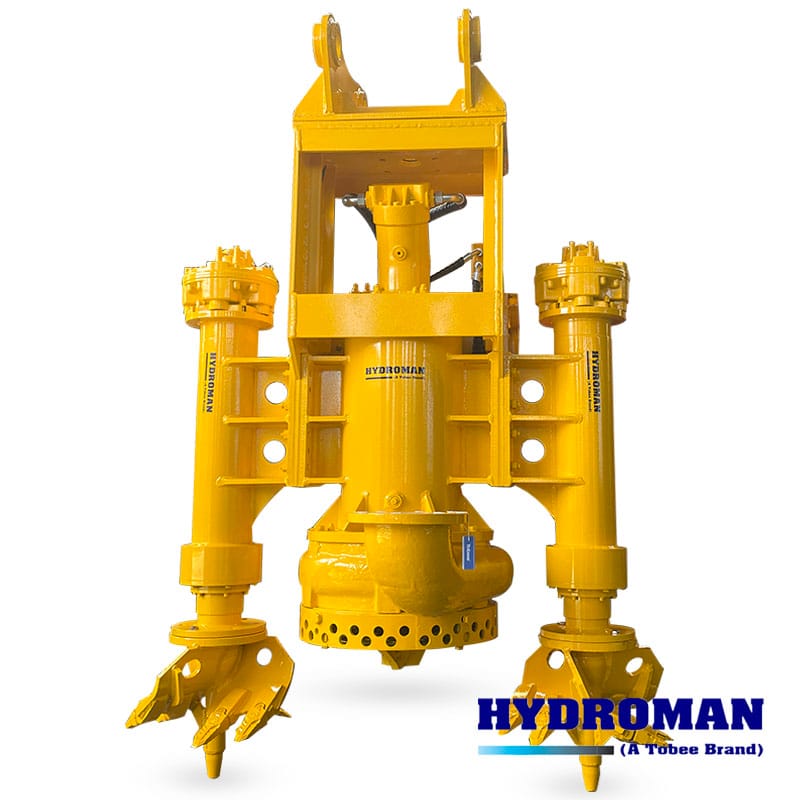
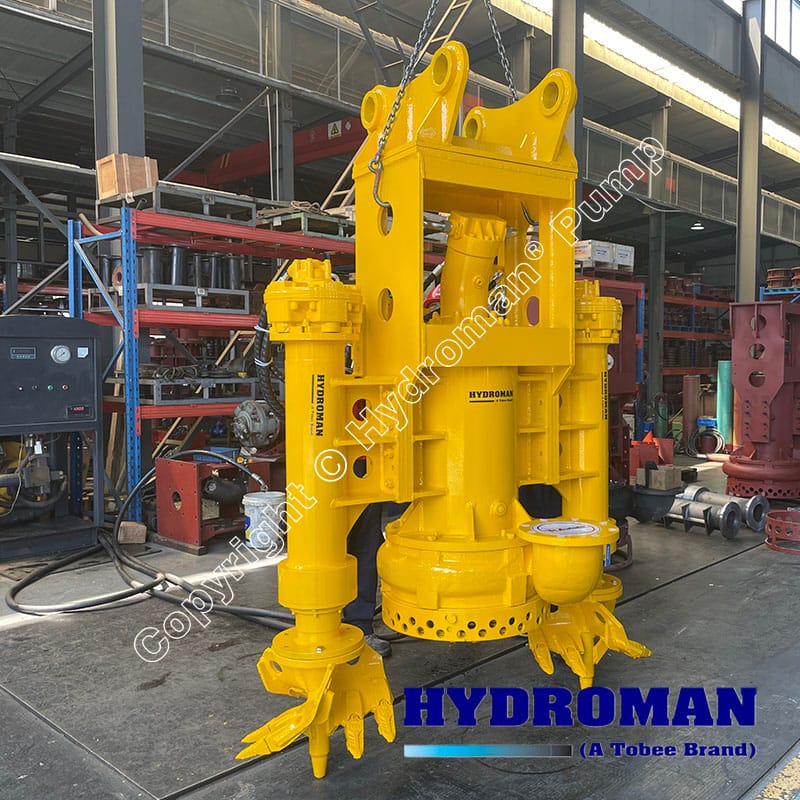
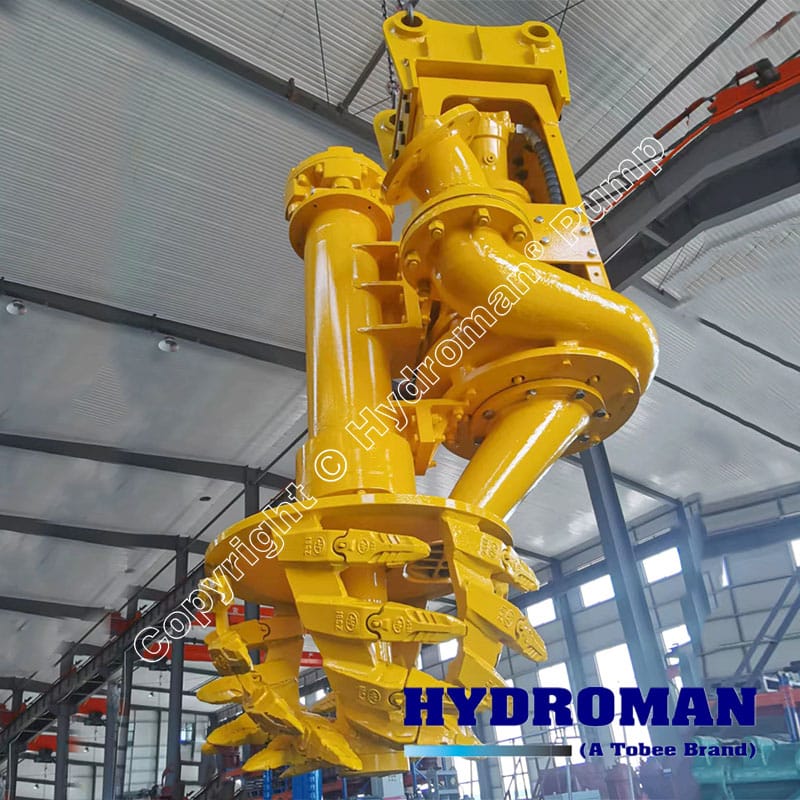
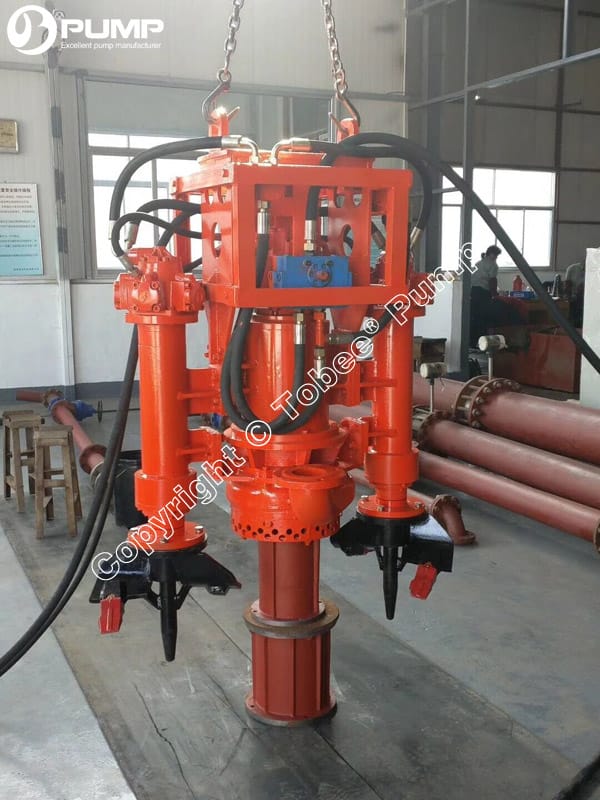
Add a cutter head assembly to the inlet, and you extend that capability further still. The rotating cutter head agitates and breaks apart compacted sediment and mud, hardened sand deposits, and consolidated material that a standard pump opening couldn't ingest on its own. This is particularly important in sand dredging operations where riverbeds or lake floors have had years — sometimes decades — to consolidate. The cutter head loosens, the pump moves. It's a straightforward workflow that translates directly to higher production rates with fewer interruptions.
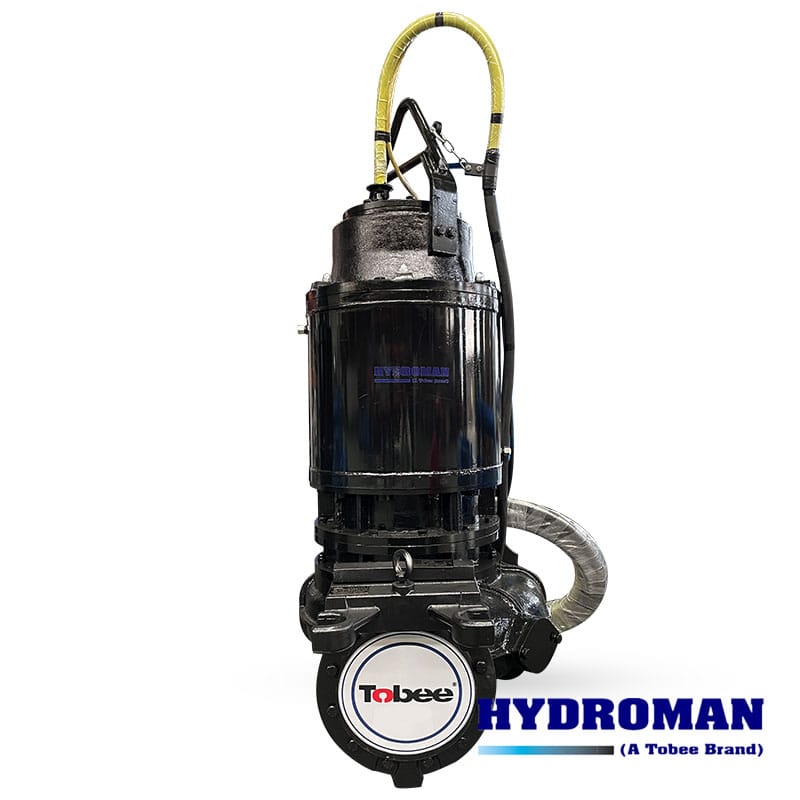
For applications like underwater slurry pump deployment in confined marine areas or deep mine sumps, the submersible configuration also provides an operational flexibility that surface-mounted equipment simply can't match. You lower it in, connect your discharge line and power supply, and work.
• Sustained high-solids pumping without the maintenance spiral. The Hydroman® pump handles slurry concentrations between 40% and 70% solids by weight — a range where most conventional pumps have already failed or been pulled for emergency maintenance. In practical terms, that means you're moving more material per cubic meter of water, which reduces your overall pumping costs and extends the operational window of each deployment.
• Direct underwater operation. There's no priming required, no suction line to maintain, and no concern about losing prime when conditions change. The Hydroman pump sits in the material and works. This is especially valuable in tidal or fluctuating water level environments common in marine dredging and port maintenance work, where surface-mounted systems constantly fight changing conditions.
• Wear-resistant construction across every wetted component. Internal wear is the operational cost nobody wants to talk about, but it's where the real money goes in any slurry pumping application. Hydroman® pumps are built with high chrome alloy (28% Cr) rotors and volute casings as standard for abrasive applications, with stainless steel, duplex stainless, and ductile iron options available depending on your corrosion and wear profile. The mechanical seal system uses dual tungsten carbide or silicon carbide faces with a self-contained flushing circuit — a configuration that extends seal life significantly in gritty, abrasive slurry environments compared to standard elastomeric seals.
• Large solids passage. Larger models in the Hydroman® line pass solids up to 120mm in diameter. For sand and gravel dredging applications where oversized material is a constant concern, this prevents the cycle of blockages, shutdowns, and manual clearing that destroys productivity on conventional systems.
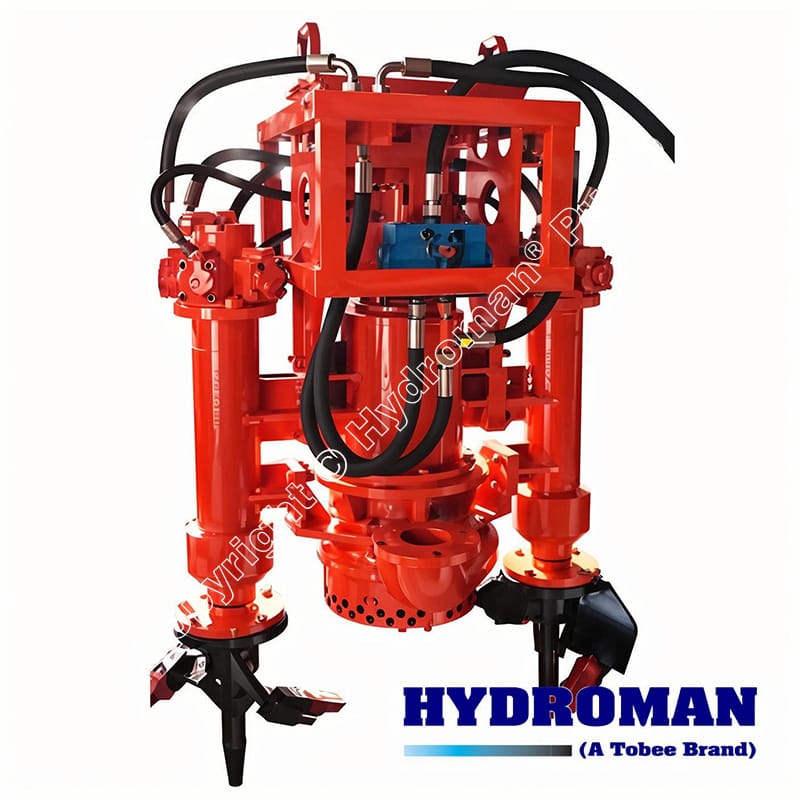
• Electric and hydraulic drive options. Fixed installations with reliable power infrastructure typically use the electric submersible dredge pump configuration. Mobile operations, excavator-mounted deployments, and remote sites without grid power often favor the hydraulic configuration, which can be driven from excavator hydraulics or a dedicated hydraulic power pack. Both deliver equivalent performance in the pump itself — the drive choice comes down to your site logistics.
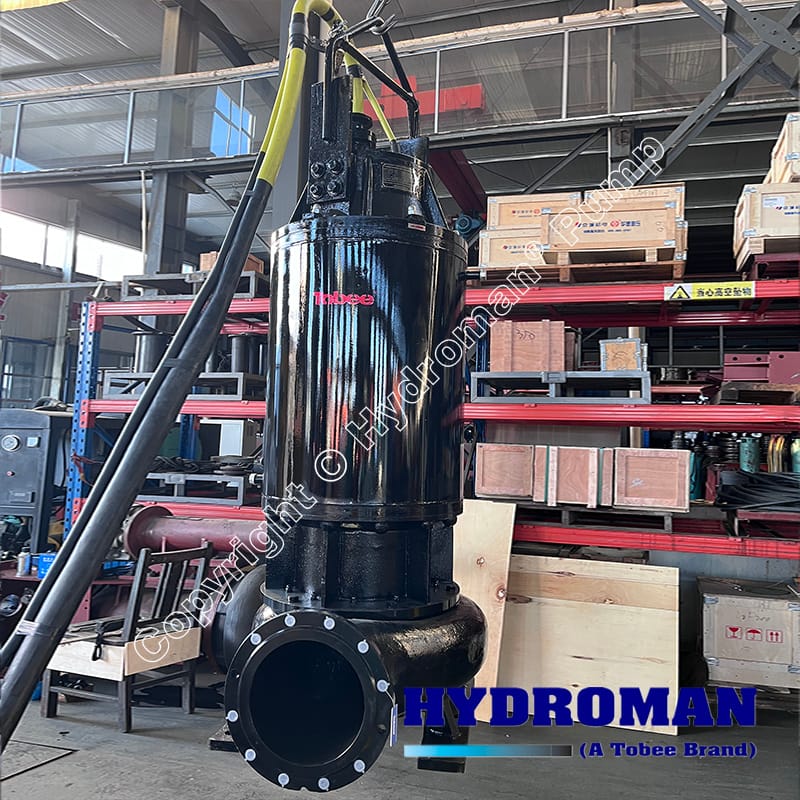
• Horizontal and vertical deployment. Most applications call for vertical deployment, but confined spaces — tunnels, narrow sumps, restricted tank interiors — sometimes require horizontal orientation. Hydroman® pumps can also provide tunnel slury pump for your requiremens.
• Low operational footprint. A submersible sand dredging pump deployed directly in the excavation area has no surface footprint beyond the discharge pipeline and power/hydraulic lines. For port maintenance, urban waterway dredging, or confined industrial sites, this matters enormously.
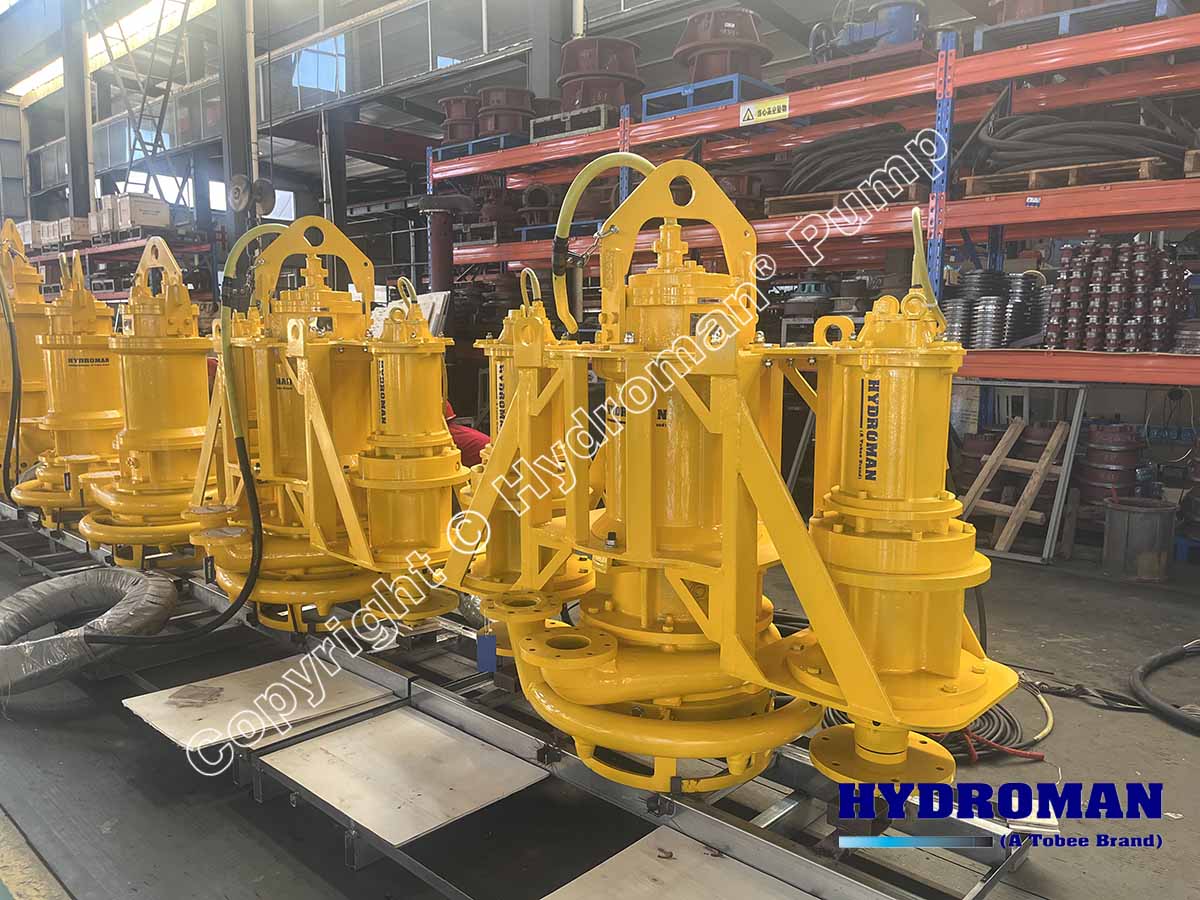
| Parameter | Specification |
|---|---|
| Flow Range | 1 – 7,300 GPM |
| Head Range | Up to 492 ft (150 m) |
| Solids Handling | Up to 4.7 inches (120 mm) diameter |
| Solids Concentration | 40–70% by weight |
| Production Rate | Up to 600 yd³/hr |
| Pump Speed | Variable depending on model and drive configuration |
| Efficiency Range | Optimized per model across operating flow range |
| Parameter | Specification |
|---|---|
| Discharge Size | 2–24 inches |
| Suction Size | 1.5–14 inches |
| Pump Orientation | Vertical or Horizontal |
| Submersible Depth | Rated for full submersion; model-dependent depth ratings |
| Cooling Method | Fluid-cooled motor jacket (submersed operation) |
| Mounting Options | Pontoon, excavator arm, fixed frame, crane-deployed |
| Component | Available Materials |
|---|---|
| Rotor / Impeller | High Chrome 28%, Ductile Iron, Stainless Steel, Duplex Stainless |
| Volute Casing | High Chrome 28%, Ductile Iron, Stainless Steel, Duplex Stainless |
| Shaft | Chromoly Steel or Stainless Steel |
| Mechanical Seal | Dual Tungsten Carbide or Silicon Carbide, self-contained flush |
| Bearing Housing | Ductile Iron or Stainless Steel |
| Cutter Head | Hardened alloy steel with replaceable teeth |
All specifications vary by model. Contact Hydroman® for model-specific data sheets and pump curves.
No. | Model | Size | Capacity Q | Head H | Power P | Eff. η | Speed n | Max. particles | Weight |
|---|---|---|---|---|---|---|---|---|---|
(mm) | (m³/h) | (m) | (kw) | (%) | (r/min) | (mm) | (kg) | ||
| 1 | 50TJQ10-20-3 | 50 | 10 | 20 | 3 | 37 | 1460 | 8 | 110 |
| 2 | 50TJQ15-18-3 | 50 | 15 | 18 | 3 | 46 | 1460 | 8 | 110 |
| 3 | 50TJQ20-15-3 | 50 | 20 | 15 | 3 | 52 | 1460 | 8 | 110 |
| 4 | 50TJQ25-12-3 | 50 | 25 | 12 | 3 | 58 | 1460 | 8 | 110 |
| 5 | 65TJQ30-12-3 | 65 | 30 | 12 | 3 | 60 | 1460 | 8 | 110 |
| 6 | 65TJQ35-10-3 | 65 | 35 | 10 | 3 | 64 | 1460 | 8 | 110 |
| 7 | 65TJQ40-8-3 | 65 | 40 | 8 | 3 | 66 | 1460 | 8 | 110 |
| 8 | 50TJQ15-22-4 | 50 | 15 | 22 | 4 | 43 | 1460 | 10 | 113 |
| 9 | 50TJQ18-20-4 | 50 | 18 | 20 | 4 | 46 | 1460 | 10 | 113 |
| 10 | 50TJQ20-18-4 | 50 | 20 | 18 | 4 | 50 | 1460 | 10 | 113 |
| 11 | 50TJQ25-20-4 | 50 | 25 | 20 | 4 | 52 | 1460 | 10 | 113 |
| 12 | 65TJQ30-16-4 | 65 | 30 | 16 | 4 | 52 | 1460 | 10 | 113 |
| 13 | 65TJQ35-15-4 | 65 | 35 | 15 | 4 | 60 | 1460 | 10 | 113 |
| 14 | 65TJQ40-12-4 | 65 | 40 | 12 | 4 | 63 | 1460 | 10 | 113 |
| 15 | 65TJQ45-10-4 | 65 | 45 | 10 | 4 | 66 | 1460 | 10 | 113 |
| 16 | 80TJQ20-30-5.5 | 80 | 20 | 30 | 5.5 | 42 | 1460 | 13 | 205 |
| 17 | 80TJQ30-20-5.5 | 80 | 30 | 20 | 5.5 | 54 | 1460 | 13 | 205 |
| 18 | 80TJQ45-15-5.5 | 80 | 45 | 15 | 5.5 | 41 | 1460 | 13 | 205 |
| 19 | 80TJQ15-20-5.5 | 80 | 15 | 20 | 5.5 | 33 | 1460 | 13 | 205 |
| 20 | 80TJQ50-10-5.5 | 80 | 50 | 10 | 5.5 | 44 | 1460 | 13 | 205 |
| 21 | 80TJQ15-20-7.5 | 80 | 15 | 20 | 7.5 | 34 | 1460 | 13 | 210 |
| 22 | 80TJQ20-25-7.5 | 80 | 20 | 25 | 7.5 | 35 | 1460 | 13 | 210 |
| 23 | 80TJQ25-20-7.5 | 80 | 25 | 20 | 7.5 | 36 | 1460 | 13 | 210 |
| 24 | 80TJQ25-30-7.5 | 80 | 25 | 30 | 7.5 | 36 | 1460 | 13 | 210 |
| 25 | 80TJQ30-30-7.5 | 80 | 30 | 30 | 7.5 | 37 | 1460 | 13 | 210 |
| 26 | 80TJQ32-20-7.5 | 80 | 32 | 20 | 7.5 | 37 | 1460 | 13 | 210 |
| 27 | 80TJQ45-15-7.5 | 80 | 45 | 15 | 7.5 | 41 | 1460 | 13 | 210 |
| 28 | 100TJQ100-10-7.5 | 100 | 100 | 10 | 7.5 | 48 | 1460 | 21 | 220 |
| 29 | 80TJQ25-40-11 | 80 | 25 | 40 | 11 | 36 | 1460 | 13 | 300 |
| 30 | 80TJQ40-25-11 | 80 | 40 | 25 | 11 | 38 | 1460 | 13 | 240 |
| 31 | 80TJQ50-21-11 | 80 | 50 | 21 | 11 | 40 | 1460 | 13 | 240 |
| 32 | 80TJQ50-26-11 | 80 | 50 | 26 | 11 | 40 | 1460 | 13 | 240 |
| 33 | 80TJQ70-20-11 | 80 | 70 | 20 | 11 | 43 | 1460 | 13 | 240 |
| 34 | 100TJQ100-18-11 | 100 | 100 | 18 | 11 | 48 | 1460 | 21 | 240 |
| 35 | 80TJQ25-40-15 | 80 | 25 | 40 | 15 | 37 | 1460 | 13 | 330 |
| 36 | 80TJQ50-26-15 | 80 | 50 | 26 | 15 | 40 | 1460 | 13 | 260 |
| 37 | 80TJQ50-28-15 | 80 | 50 | 28 | 15 | 40 | 1460 | 13 | 260 |
| 38 | 100TJQ60-30-15 | 100 | 60 | 30 | 15 | 41 | 1460 | 13 | 265 |
| 39 | 80TJQ70-24-15 | 80 | 70 | 24 | 15 | 42 | 1460 | 13 | 260 |
| 40 | 100TJQ75-25-15 | 100 | 75 | 25 | 15 | 43 | 1460 | 13 | 260 |
| 41 | 100TJQ100-18-15 | 100 | 100 | 18 | 15 | 49 | 1460 | 21 | 270 |
| 42 | 100TJQ150-15-15 | 100 | 150 | 15 | 15 | 51 | 1460 | 21 | 270 |
| 43 | 150TJQ150-18-18.5 | 150 | 150 | 18 | 18.5 | 49 | 980 | 32 | 550 |
| 44 | 150TJQ200-12-18.5 | 150 | 200 | 12 | 18.5 | 53 | 980 | 45 | 550 |
| 45 | 150TJQ150-22-22 | 150 | 150 | 22 | 22 | 47 | 980 | 32 | 600 |
| 46 | 150TJQ200-15-22 | 150 | 200 | 15 | 22 | 50 | 980 | 45 | 600 |
| 47 | 150TJQ60-46-30 | 150 | 60 | 46 | 30 | 41 | 980 | 14 | 550 |
| 48 | 150TJQ70-38-30 | 150 | 70 | 38 | 30 | 42 | 980 | 21 | 710 |
| 49 | 150TJQ100-35-30 | 150 | 100 | 35 | 30 | 44 | 980 | 21 | 710 |
| 50 | 150TJQ108-30-30 | 150 | 108 | 30 | 30 | 44 | 980 | 21 | 710 |
| 51 | 150TJQ150-30-30 | 150 | 150 | 30 | 30 | 46 | 980 | 21 | 710 |
| 52 | 150TJQ150-35-30 | 150 | 150 | 35 | 30 | 46 | 980 | 21 | 710 |
| 53 | 150TJQ200-20-30 | 150 | 200 | 20 | 30 | 52 | 980 | 21 | 710 |
| 54 | 150TJQ240-20-30 | 150 | 240 | 20 | 30 | 55 | 980 | 21 | 710 |
| 55 | 200TJQ300-15-30 | 200 | 300 | 15 | 30 | 56 | 980 | 28 | 700 |
| 56 | 150TJQ100-50-37 | 150 | 100 | 50 | 37 | 44 | 980 | 21 | 850 |
| 57 | 200TJQ300-20-37 | 200 | 300 | 20 | 37 | 56 | 980 | 28 | 775 |
| 58 | 200TJQ400-15-37 | 200 | 400 | 15 | 37 | 58 | 980 | 28 | 775 |
| 59 | 150TJQ150-35-45 | 150 | 150 | 35 | 45 | 47 | 980 | 36 | 1000 |
| 60 | 150TJQ200-30-45 | 150 | 200 | 30 | 45 | 49 | 980 | 36 | 1110 |
| 61 | 200TJQ500-15-45 | 200 | 500 | 15 | 45 | 59 | 980 | 46 | 1100 |
| 62 | 150TJQ150-45-55 | 150 | 150 | 45 | 55 | 46 | 980 | 21 | 1140 |
| 63 | 150TJQ250-35-55 | 150 | 250 | 35 | 55 | 51 | 980 | 36 | 1140 |
| 64 | 250TJQ600-15-55 | 250 | 600 | 15 | 55 | 60 | 980 | 46 | 1220 |
| 65 | 150TJQ200-45-75 | 150 | 200 | 45 | 75 | 49 | 980 | 21 | 1540 |
| 66 | 150TJQ200-50-75 | 150 | 200 | 50 | 75 | 48 | 980 | 14 | 1550 |
| 67 | 200TJQ350-35-75 | 200 | 350 | 35 | 75 | 53 | 980 | 28 | 1550 |
| 68 | 200TJQ400-25-75 | 200 | 400 | 25 | 75 | 58 | 980 | 25 | 1550 |
| 69 | 200TJQ500-20-75 | 200 | 500 | 20 | 75 | 59 | 980 | 25 | 1550 |
| 70 | 150TJQ200-60-90 | 150 | 200 | 60 | 90 | 48 | 980 | 14 | 1550 |
| 71 | 200TJQ400-40-90 | 200 | 400 | 40 | 90 | 54 | 980 | 28 | 1550 |
| 72 | 200TJQ500-25-90 | 200 | 500 | 25 | 90 | 60 | 980 | 25 | 1550 |
| 73 | 200TJQ400-50-110 | 200 | 400 | 50 | 110 | 53 | 980 | 28 | 1970 |
| 74 | 250TJQ600-30-110 | 250 | 600 | 30 | 110 | 61 | 980 | 28 | 1970 |
| 75 | 300TJQ780-26-110 | 300 | 780 | 26 | 110 | 62 | 980 | 50 | 1970 |
| 76 | 300TJQ1000-18-110 | 300 | 1000 | 18 | 110 | 64 | 980 | 50 | 1970 |
| 77 | 200TJQ400-60-132 | 200 | 400 | 60 | 132 | 53 | 980 | 28 | 2000 |
| 78 | 200TJQ500-45-132 | 200 | 500 | 45 | 132 | 56 | 980 | 28 | 2000 |
| 79 | 200TJQ500-55-132 | 200 | 500 | 55 | 132 | 55 | 980 | 28 | 2000 |
| 80 | 300TJQ800-35-132 | 300 | 800 | 35 | 132 | 63 | 980 | 42 | 2000 |
| 81 | 300TJQ1000-22-132 | 300 | 1000 | 22 | 132 | 64 | 980 | 50 | 2000 |
| 82 | 200TJQ650-52-160 | 200 | 650 | 52 | 160 | 58 | 980 | 28 | 2650 |
| 83 | 300TJQ780-50-185 | 300 | 780 | 50 | 185 | 60 | 980 | 38 | 3330 |
| 84 | 250TJQ600-55-200 | 250 | 600 | 55 | 200 | 62 | 980 | 28 | 4080 |
| 85 | 300TJQ800-55-220 | 300 | 800 | 55 | 220 | 60 | 980 | 38 | 3400 |
| 86 | 350TJQ1250-35-220 | 350 | 1250 | 35 | 220 | 65 | 980 | 45 | 3400 |
| 87 | 350TJQ1750-30-250 | 350 | 1750 | 30 | 250 | 70 | 980 | 55 | 3750 |
| 88 | 350TJQ1500-35-250 | 350 | 1500 | 35 | 250 | 70 | 980 | 50 | 3750 |
| 89 | 350TJQ1750-40-315 | 350 | 1750 | 40 | 315 | 70 | 980 | 55 | 4200 |
| 90 | 400TJQ2000-35-315 | 400 | 2000 | 35 | 315 | 72 | 980 | 60 | 3800 |
The Hydroman® submersible slurry dredge pump range covers everything from small-scale industrial tank cleaning up to large production mining dredge pump deployments moving thousands of gallons per minute.
For smaller-scale sludge handling or tank interior cleaning, the 50TJQ and 100TJQ are straightforward choices. The mid-range models — 150TJQ through 200TJQ — cover the bulk of sand dredging pump applications, river sediment removal, and medium-scale mining operations. If you're running a high-production mining dredge pump setup, the 250JTQ through 400TJQ deliver the flow capacity and solids handling to sustain continuous large-volume material transfer without the maintenance cycles that interrupt production.
Mining and Tailings Transfer
In mineral processing operations, the slurry leaving a mill or processing circuit is among the most demanding pumping challenges in any industry. Tailings from copper, gold, and iron ore processing routinely run at 55–65% solids by weight, contain particles ranging from fine clay to coarse rock fragments, and must be transported reliably over long distances — sometimes more than a mile — from the processing plant to the tailings storage facility.
Conventional centrifugal pumps managing these conditions typically require impeller replacement every four to eight weeks in abrasive ore tailings. The Hydroman® mining dredge pump, built with high chrome wear components and a mechanical seal system rated for continuous abrasive service, extends component life well beyond that baseline while maintaining stable flow at the high slurry densities that characterize mineral tailings transfer.
|  |
 | Sand Dredging and Sediment Removal
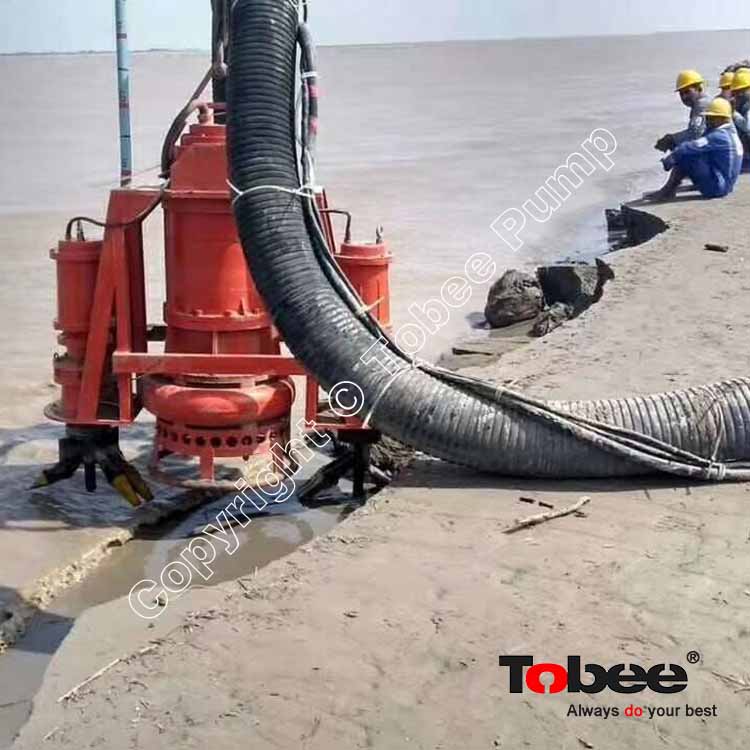
River dredging, lake desilting, harbor maintenance, and commercial sand extraction all share the same fundamental challenge: you need to move a large volume of material, much of it consolidated by time and water pressure, from the bottom of a water body to a processing or disposal point — efficiently, continuously, and without constant mechanical intervention.
The global dredging market processes roughly 500 to 700 million cubic meters of material annually, a figure that continues to grow as port infrastructure expands and waterway maintenance requirements intensify. Within that market, submersible dredging pump technology has gained substantial ground over traditional cutter suction dredger configurations for smaller to medium-scale operations because of its deployment flexibility and lower capital cost.
The Hydroman® submersible sand dredging pump with cutter head delivers the core capability of a cutter suction dredger in a package that can be mounted on a small pontoon, lifted by a standard excavator, or crane-deployed from a work vessel. |
Wastewater and Sludge Handling
Municipal wastewater treatment facilities deal with a specific category of difficult material: biological sludge, grit, and settled biosolids that are viscous, variable in composition, and genuinely unpleasant to work when equipment fails. For industrial wastewater streams with chemical contamination, that is more complicated.
The non-clog pump design in the Hydroman® series — which uses a larger, more open flow path geometry compared to conventional impeller designs — maintains stable throughput in high-viscosity sludge streams that would stall or air-lock a standard centrifugal pump. For settling tank cleaning, clarifier sediment removal, and biosolids transfer, the smaller to mid-range models (50TJQ through 250TJQ) cover the majority of municipal and industrial wastewater applications.
Stainless steel and duplex stainless material configurations are available where chemical corrosion is a concern — a relevant option in industrial wastewater treatment facilities handling acidic or chloride-bearing process streams. | 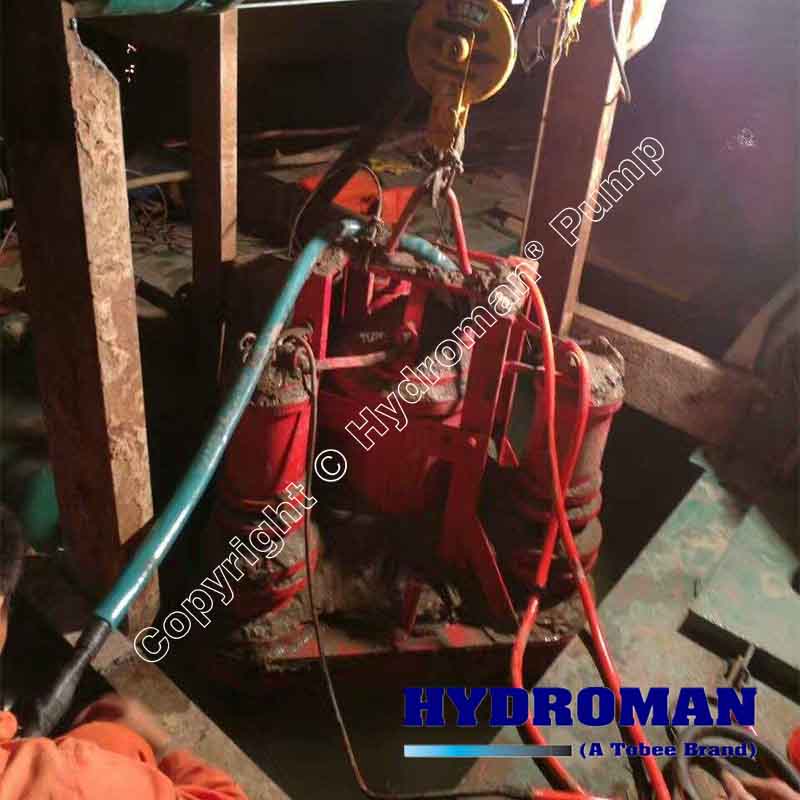 |
 | Oil, Gas, and Industrial Waste Transfer
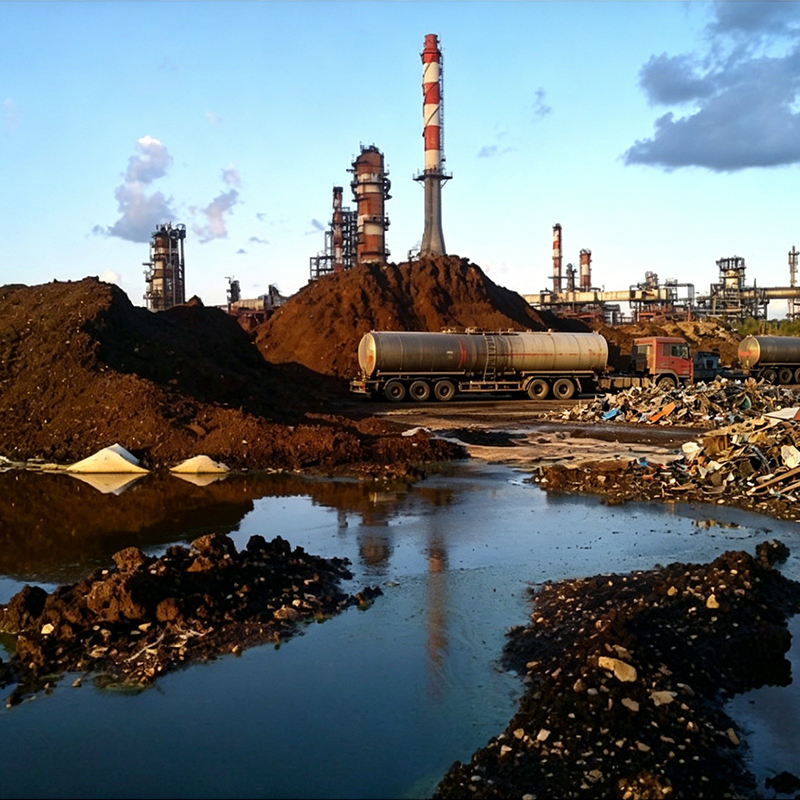
Drilling operations generate significant volumes of drilling mud — a carefully formulated mixture of water, bentonite, barite, and chemical additives that can run to specific gravities of 1.3 to 2.4 depending on formation pressure requirements. Tank cleaning at the end of a drilling campaign, sump cleanup, and drilling waste transfer are routine applications where a compact submersible slurry pump outperforms larger surface-mounted alternatives because of its ability to work inside confined rig structures and waste containment vessels.
Refinery and petrochemical facility applications follow a similar pattern: tank bottoms, API separator sediment, and industrial sludge all need to move periodically, often from confined spaces where equipment access is limited. The hydraulic drive configuration is frequently specified in these environments where electrical classification requirements complicate or prohibit motor placement. |
Power Generation and Ash Handling
Coal-fired power generation produces two primary solid waste streams that require continuous pumping: fly ash that is collected from flue gas treatment systems, and bottom ash which the coarser residue from the combustion chamber. Both are abrasive. Fly ash slurries run at specific gravities of 1.15–1.35 and are chemically reactive in the presence of water — a combination that degrades conventional pump materials quickly. Bottom ash is coarser and heavier, with particles that can reach several inches in diameter.
The Hydroman® submersible dredge pump with high chrome construction and large solids handling capability make it a practical choice for bottom ash transfer in particular, where coarse particle size rules out many alternatives. Fly ash pond maintenance — recovering settled ash from storage impoundments for disposal or beneficial reuse — is another application where the cutter head configuration improves penetration into consolidated ash deposits. |  |
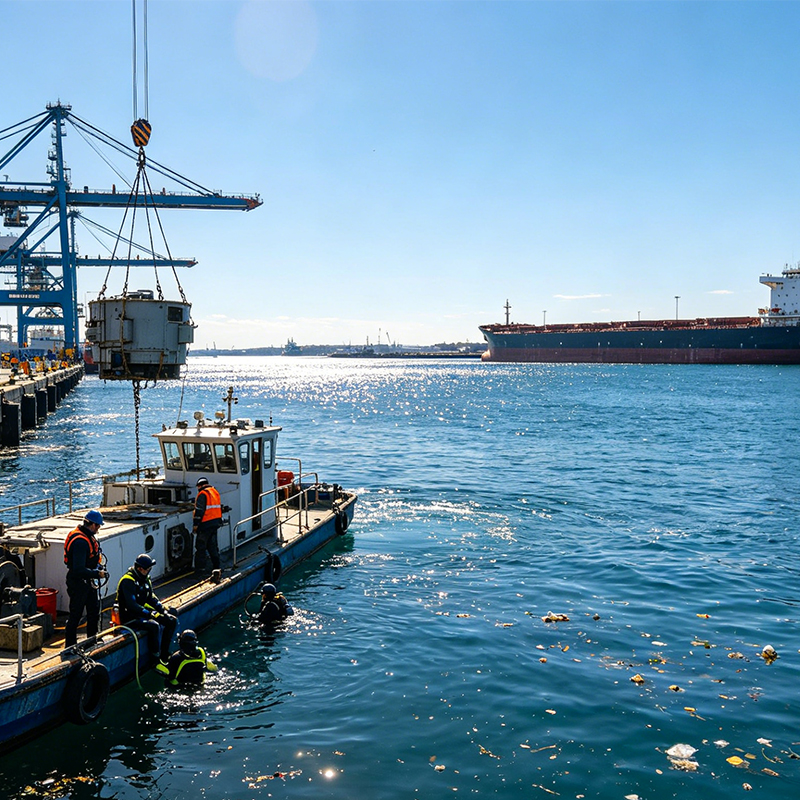 | Marine, Ports, and Waterway Maintenance
Port and harbor maintenance dredging is a continuous operational requirement at virtually every major maritime facility. Shoaling — the gradual accumulation of sediment in navigation channels and berths — reduces vessel draft clearance and creates safety risks if left unmanaged. The U.S. Army Corps of Engineers alone maintains over 25,000 miles of navigation channels, and port authorities globally spend billions annually on maintenance dredging to keep those channels and berths navigable.
For maintenance dredging at smaller ports, marinas, and waterway facilities where a full-scale cutter suction dredger is neither necessary nor economically justifiable, a Hydroman® submersible dredge pump mounted on a small work pontoon provides most of the functional capability at a fraction of the capital cost. Underwater slurry pump deployments in marine environments benefit from the submersible design's indifference to wave action and tidal fluctuation — conditions that can disrupt surface-mounted pump systems significantly. |
Inland sand mining on the Mekong River delta is not a forgiving environment for pumping equipment. The river carries a heavy suspended load year-round, and during peak extraction season, operators are pulling material that shifts constantly in particle size and density — fine silt one hour, coarse river sand with shell fragments the next. For one mid-scale sand extraction contractor running two pontoon-mounted dredging platforms, that variability had become an expensive problem.
 |  |  |
The Problem | The Solution | The Outcome |
| The contractor was using a competitor’s electric submersible pump that was marketed for sand dredging but not truly designed for heavy slurry conditions. In the working area, slurry concentrations often reached 50–60% solids by weight, causing frequent cavitation, reduced flow, and rapid wear. Operators pushed the pumps harder to maintain output, but both units typically required new impellers and seal assemblies every three to four weeks. Since replacement parts had to be imported with 4–6 week lead times, each platform lost about 30 operating days per quarter, creating major revenue losses at local sand prices of $8–12 USD per cubic meter. | The contractor replaced both units with Hydroman® 150TJQ submersible dredge pumps with cutter head assemblies, deployed vertically from the existing pontoon frames with minimal structural modification. The choice of the 150TJQ came down to three factors specific to this operation: the 6-inch discharge matched the existing pipeline runs without modification, the 4-inch solids handling capacity gave comfortable margin above the coarse shell fragments regularly encountered in that stretch of river, and the high chrome 28% rotor and volute configuration was the appropriate material choice for continuous abrasive sand service. | Across the first six months of operation, neither unit required an unplanned pull from the water. Scheduled maintenance — seal inspection and wear measurement — was conducted at the three-month mark, and both pumps were returned to service the same day with no component replacement required. The contractor's quarterly downtime dropped from approximately 30 days per platform to under 12, and annual sand extraction volume across both platforms increased by an estimated 35%. The cutter head teeth showed expected wear at three months and were replaced as a routine item — a planned cost, not a production crisis. |
The operation manager's assessment was straightforward: the previous pumps were priced lower upfront and cost more to run. The Hydroman® units were priced higher and cost less. On a two-platform operation running 10-hour shifts six days a week, that difference accumulates quickly.
You have options in the submersible dredge pump market. Chinese, European, and American manufacturers all compete in this space, and the specification sheets often look similar at first glance. Here's where the difference shows up in practice.
Engineering support before the sale. Sizing a submersible slurry pump correctly requires real application data — slurry density, particle size distribution, discharge distance, head change, operating depth, production targets. Hydroman®'s technical team works through that data with you before you commit to a configuration, not after. Getting the model right the first time saves more money than any unit price difference.
Genuine wear part availability. The economic argument for any pump breaks down if wear parts are unavailable or priced at a premium because they're proprietary. Hydroman® maintains parts inventory for the full model range, with consistent lead times that support planned maintenance intervals rather than emergency sourcing.
OEM and custom engineering. For operators running non-standard applications — unusual discharge configurations, specialized material requirements, integration with existing hydraulic systems — Hydroman® supports OEM and custom engineering engagements. If the standard product line doesn't precisely fit your application, we can provide custom solution.
Export experience and global delivery. Hydroman® equipment operates on dredging and mining projects across Southeast Asia, South America, Africa, the Middle East, and Europe. The logistics of getting large industrial pump equipment to remote project sites — customs documentation, crating, freight coordination — are familiar operational territory, not a special project.
Proven performance data, not marketing claims. Pump curves, efficiency maps, and wear life data for each model are available for review before purchase. If a competitor can't show you the pump curve for the model they're quoting, that's a meaningful signal about the depth of their technical documentation.
Getting the pump selection right requires answering a specific set of questions about your application. Work through these before requesting a quote, and you'll have a much more productive conversation with the technical team.
Hydroman®'s technical team can work through this selection process with you if you provide your application data. Model-specific pump curves and performance data sheets are available upon request.
What types of slurry can the Hydroman® submersible dredge pump handle?
Hydroman pump submerible dredge pump handles abrasive, high-density, and viscous slurries including mining tailings, dredged river and lake sediment, wastewater sludge, drilling mud, fly ash and bottom ash slurry, sand, gravel, and general industrial waste. The non-clog flow path design maintains throughput in material streams that routinely stall conventional centrifugal pumps.
Are pump curves and spec sheets available?
Yes, for every model in the lineup. Pump performance curves showing flow versus head across the operating range, along with dimensional drawings, power requirements, and material specifications, are available for review. Contact the Hydroman® team to request documentation for specific models.
When should I choose a submersible dredge pump over a self-priming slurry pump?
Choose the submersible configuration when your pump needs to operate inside the slurry — in ponds, pits, lagoons, underwater excavations, or tanks — or when suction lift limitations are affecting your self-priming pump's performance. For applications where the pump can be positioned above the slurry and suction distance is manageable, self-priming configurations work well. For underwater dredging and high-solids submerged applications, the submersible design is the better technical choice.
What's the largest solid that can pass through the pump?
The 400TJQ the largest model in the lineup, passes solids up to 5 inches in diameter. Smaller models have proportionally smaller solids handling ratings — from 0.75 inches on the 100TJQ up through the range. Always select a model whose solids handling diameter exceeds your expected maximum particle size.
Can the pump operate vertically?
Yes. the hydroman submersible slurry pump is installed vertically.
What material construction should I specify for my application?
High chrome 28% is the standard recommendation for highly abrasive applications — mining tailings, coarse sand dredging, ash handling. Stainless steel and duplex stainless are appropriate where corrosion is the primary concern, such as seawater dredging or chemically aggressive industrial slurry. Cast iron is a cost-effective option for lower-abrasion applications. If you're unsure, share your slurry chemistry and particle size data with the Hydroman® team and they'll recommend the right configuration.
Are electric and hydraulic versions available for all models?
Yes, the Hydroman electric submersible dredge pump configurations and hydraulic drive options are available across the product range. Electric is standard for fixed installations with available grid or generator power. Hydraulic configurations are specified for excavator-mounted dredging, mobile operations, and remote sites without reliable electrical infrastructure.
What factors most affect pump selection?
In order of importance: required flow rate, total dynamic head, slurry specific gravity, maximum solids size, operating depth, and drive type. Production rate targets (yd³/hr) and discharge distance are also key inputs for sizing the complete system, not just the pump.
What maintenance advantages does the Hydroman® design provide?
The non-clog pump geometry reduces the internal recirculation and blockage patterns that accelerate wear in conventional slurry pumps. High chrome wear components extend replacement intervals significantly in abrasive service. The dual mechanical seal with self-contained flushing reduces seal failure rates in gritty slurry environments. Combined, these design choices move maintenance from a reactive, emergency-driven activity toward a predictable, planned schedule — which is where operations need it to be.
If you're selecting a submersible dredge pump for a specific project, the most useful next step is a conversation with someone who can work through your application data and point you toward the right model configuration. Hydroman® provides technical consultation as part of the sales process — not as an add-on.
Provide your flow requirement, head, slurry characteristics, and deployment environment, and you'll get a model recommendation with supporting pump curve data rather than a generic specification sheet.
Hydroman® — Submersible Dredge Pumps Built for Real Conditions.
 Sara Liang
 +86 189 3110 6396 (Whatsapp/Wechat)
 Inquiry@tobeepump.com
Submitted successfully
Your submission has been received. Thanks for your time

 FR(EUR)
 CN(CNY)
 GB(GBP)
 AU(AUD)







Reviews
0%
0%
0%
0%
0%
Share your thoughts with other customers
Write a Review