
 FR(EUR)
 CN(CNY)
 GB(GBP)
 AU(AUD)
Blog
Suction Dredge Systems Explained: Slurry Pump Technology, Efficiency, and Applications
- Jul.01, 2026 14:49:16
- 0 Comments
A working guide to how suction dredge pumps move sediment, which pump type fits your job, and what real production numbers look like — written for the people who actually run these machines.
Table of Contents
- Introduction
- What Is a Suction Dredge System?
- How Suction Dredge Systems Work
- Types of Dredge Pumps Used in Suction Dredging Systems
- Key Applications of Suction Dredge Systems
- Key Advantages of Suction Dredge Systems
- How to Choose the Right Dredge Pump
- Dredge Pump Price and Buying Considerations
- Why Hydroman Dredge Pumps for Suction Dredging Systems
- Conclusion
Introduction
If you've ever stood at the edge of a silted-up pond, a sand pit losing depth, or a tailings lagoon that's crept closer to capacity every season, you already know the problem a suction dredge pump solves. Sediment doesn't wait for a convenient budget cycle. It builds up in rivers, harbors, irrigation channels, gold-bearing riverbeds, and industrial ponds until someone has to move it — and moving wet, abrasive, unpredictable material is a very different challenge than pumping clean water.
That's where suction dredging comes in. Instead of digging with buckets or draglines, a suction dredge system pulls sediment, sand, silt, and slurry directly through a pipeline using a purpose-built dredging pump, then carries it to wherever it needs to go — a settling pond, a stockpile, a processing plant, or back onto reclaimed land. It's continuous, it's scalable, and when the pump is sized correctly, it's dramatically more cost-effective per cubic meter than mechanical excavation.
The global dredging equipment market reflects just how central this technology has become to modern infrastructure. Depending on the research house, the market is valued anywhere from roughly USD 6 billion to USD 9 billion in 2025, with most forecasts putting steady annual growth in the 4.5–5.6% range through the early 2030s, pushed along by port deepening, land reclamation, offshore wind seabed prep, and reservoir desilting. Hydraulic dredgers alone account for the majority of equipment revenue in several of these reports — which tells you plainly that pump-driven suction systems, not mechanical buckets, are doing most of the heavy lifting in this industry today.
~$6–9B Global dredging equipment market, 2025 | 4.5–5.6% Typical forecast CAGR through 2030–2034 | 70–80% Hydraulic efficiency of a well-matched submersible dredge pump |
In this guide, you'll get a straight walkthrough of how a water dredge pump system actually works, the difference between a submersible dredge pump, a hydraulic dredge pump, and an electric dredge pump, where each one earns its keep, and how to size and price a pump for your own project — whether that's a backyard gold suction pump setup or an excavator-mounted rig moving thousands of cubic meters a day.
What Is a Suction Dredge System?
A suction dredge system is, at its core, a pump-and-pipe arrangement that removes underwater material by suction rather than mechanical scooping. Sediment, sand, silt, gravel, and organic muck are drawn in through an intake, mixed with water into a pumpable slurry, and pushed through a discharge line to a disposal or processing point. No crane, no bucket, no repeated lifting cycle — just continuous flow.
A basic system is built from four parts:
- The dredge pump itself — typically a centrifugal or specialized dredge water pump designed for high-solids slurry rather than clean water.
- A suction pipeline — the intake side, where the mixture of water and solids enters the system, often fitted with a cutter head, agitator, or jet ring to loosen compacted material.
- A discharge pipeline — floating or land-laid pipe that carries the slurry to its destination, sometimes over very long distances.
- A booster pump — added into the line when the discharge distance is long enough that a single dredge pump can't maintain head pressure on its own.
What sets an underwater dredge pump apart from an ordinary submersible water pump is the wet end. The impeller, volute, and liner are built from wear-resistant materials — usually high-chrome cast iron or rubber-lined alloys — because dredge slurry is abrasive in a way clean water simply isn't. A submersible dredge pump running fine sand at 40–70% solids by volume wears differently, and needs different metallurgy, than a pump moving lake water.
How Suction Dredge Systems Work (Working Principle)
Step-by-step operation process
The operating sequence is straightforward once you've seen it run: suction intake pulls in sediment at the pump or cutter head, that material blends with water to form a pumpable slurry, the slurry travels through the pipeline under pressure generated by the impeller, and finally it discharges to a storage area, settling pond, or processing site. The entire cycle repeats continuously rather than in the stop-start rhythm of mechanical dredging, which is a big part of why suction systems post such strong production numbers per hour of operation.
The pump's role inside the system
A centrifugal dredge pump is the workhorse of most systems. Water and solids enter near the center of a spinning impeller, and centrifugal force throws the mixture outward into the volute casing and out the discharge port. It's a simple, reliable mechanism — the engineering challenge is keeping that impeller alive when it's chewing through sand and gravel eight hours a day.
For compacted soil, clay, or consolidated sediment that won't loosen on its own, a cutter suction pump adds a rotating cutter head at the intake to break material apart before it's drawn into the pump. And when the job involves debris — roots, plastic, rope, rocks — a trash pump dredge configuration with a larger solids passage and non-clog impeller keeps the system running without constant unclogging stops.
Real-world reference point: Industry pump-curve data for mid-size ROV and cable-mounted dredge units shows an 8-inch class dredge pump moving roughly 4,000 GPM at heads up to 200 ft, processing solids up to 7 inches, and sustaining 250–300 cubic yards of material per hour at 40–70% solids concentration — numbers that give you a real benchmark when you're comparing quotes. |
Types of Dredge Pumps Used in Suction Dredging Systems
Not every dredging job calls for the same equipment, and this is where most buyers either overspend or under-deliver. Here's how the main categories break down.
Submersible dredge pump
A submersible dredge pump sits underwater, right where the sediment is, instead of pulling slurry up through a long dry suction line from the surface. Because it isn't fighting suction lift, a submersible sand dredging pump typically runs more efficiently than an equivalent surface-mounted unit — well-matched submersible dredge pumps commonly reach 70–80% hydraulic efficiency under good operating conditions. That efficiency, plus a compact footprint, is why submersible units dominate pond dredging, lagoon desludging, and river or lake sediment removal where you need a machine that can work fully submerged without priming issues.
Variants exist for almost every job: a submersible dredge pump with cutter head for compacted material, ROV-style remote-operated units for hazardous or confined spaces, and cable-mounted configurations rated to work at depths up to roughly 100 ft.

Hydraulic dredge pump
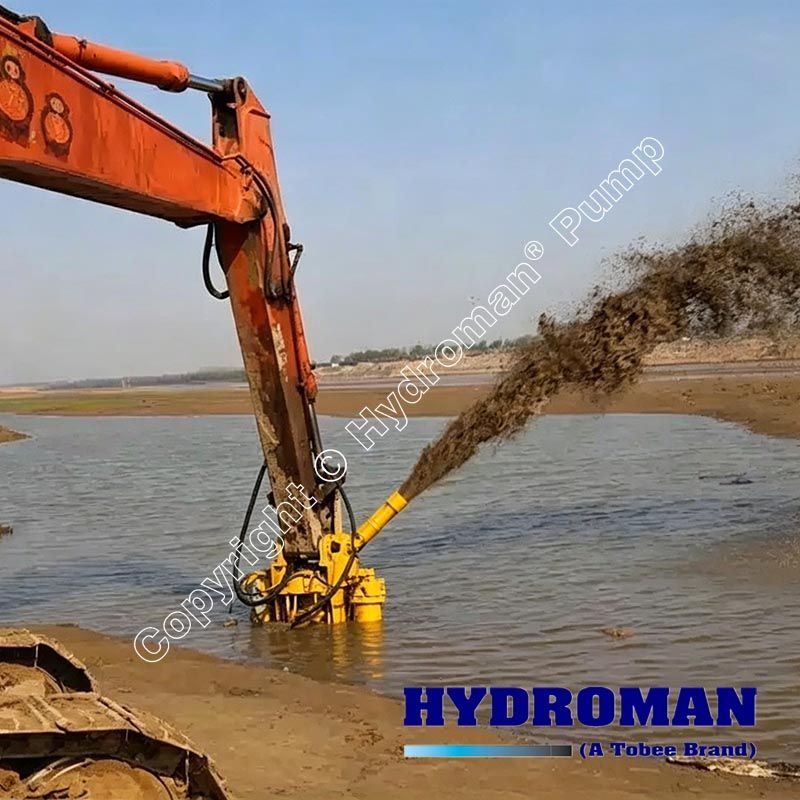
An excavator mounted dredge pump — powered off the excavator's own hydraulic circuit — turns a machine you may already own into a dredging platform. A hydraulic dredge pump replaces the electric motor with a hydraulic motor fed by a power unit, which means no electrical components sit in the water, sealing is simpler, and variable-speed flow control comes essentially for free through the hydraulic circuit. The tradeoff is system efficiency: hydraulic transmission typically runs 60–70% efficient versus 90%+ for direct electric drive, and you're managing hydraulic fluid instead of a power cable. Where excavator dredge pumps really shine is heavy-duty mining and reach-limited jobs — riverbanks, quarry faces, and mine pits where a mounted arm gives you precision an ROV can't match.
Electric dredge pump
For continuous, stationary operation — a permanent pond dredge pump installation, a wastewater lagoon, an industrial slurry line running around the clock — an electric dredge pump is usually the more cost-efficient choice over the life of the equipment. Higher drivetrain efficiency means lower energy cost per cubic meter moved, and with grid power available, an electric dredge water pump is simpler to maintain than a hydraulic power unit.
Sand and mud dredge pumps
Sand mining and pond cleaning both call for a sand dredging pump or mud dredge pump built with heavier wear liners and abrasion-resistant impellers, since fine, high-silica sand is one of the most erosive materials a pump will ever see. If you're shopping for a sand dredge pump for sale, wear-part availability matters as much as the headline flow rate — a pump that's 10% cheaper up front but needs a new impeller every six weeks isn't actually the cheaper option.
Key Applications of Suction Dredge Systems
Mining and mineral extraction
A gold dredge pump or gold suction pump is the backbone of river-based gold recovery, from small-scale prospecting rigs to commercial operations. A compact water pump for gold dredge setups draw riverbed material through a sluice box, where gold's high density lets it settle out while lighter material washes through. Hobbyist and small commercial operators looking at a gold dredge pump for sale or a small gold dredge pump generally want something in the 2-inch to 4-inch range — enough suction to move material efficiently without the footprint or cost of an industrial rig. Manual gold dredge hand pump units and simple gold panning suction pump tools still see steady use in shallow, low-volume prospecting where portability beats raw throughput. |  |
 | River, lake, and pond dredging
Ponds silt in gradually, then all at once — a few inches a year until suddenly the depth that supported fish, irrigation, or aesthetics is gone. A silt removal pump or dedicated pond dredge pump restores capacity without draining the pond, which matters when there's livestock, irrigation supply, or aquatic life depending on it. For pond suction dredge for sale listings, buyers should match pump size to the pond's actual perimeter and depth rather than defaulting to the biggest unit available — oversizing wastes fuel or power without moving material any faster once you hit the pipeline's flow limit.
It's also common to hear this described informally as "dredging a pond with a trash pump" — and for smaller ponds with soft, debris-free sediment, a trash pump dredge pond setup can genuinely work. But once you're dealing with sand, gravel, or consolidated silt, a purpose-built dredge pump with proper wear materials will outlast and outperform a general trash pump by a wide margin. |
Industrial slurry handling
Wastewater treatment plants, tailings facilities, and processing sites depend on slurry pump technology to move sediment-heavy water reliably, day after day, without unplanned downtime. This is less glamorous than a mining application but arguably higher-stakes — a clogged or worn-out pump in a treatment lagoon can back up an entire facility.
Construction and land reclamation
A dredge pump for sand feeds directly into land reclamation and coastal engineering work, where dredged sand becomes the fill material for new land, beach nourishment, or foundation prep. Land reclamation is consistently cited as one of the largest single application segments in dredging equipment market reports — in some breakdowns it's the single largest share of demand — which reflects how much of the world's coastal urban growth is quite literally built from dredged material.
Key Advantages of Suction Dredge Systems
Compared with mechanical dredging (grab buckets, clamshells, draglines), a well-matched suction dredge system offers a few clear operational wins:
- Continuous operation — no lift-swing-drop cycle, which translates directly into higher hourly production for a given horsepower.
- Long-distance transport — with a dredge booster pump added into the line at the right interval, slurry can travel well beyond what a single pump's head rating would normally allow.
- High solids handling — modern dredge pumps sustain 40–70% solids by volume without clogging, a range that would stall a standard water pump almost immediately.
- Harsh-environment tolerance — abrasive sand, corrosive slurry, and submerged operation are what these pumps are engineered for, not an edge case.
- Flexible pressure staging — a high pressure dredge pump paired with boosters lets you push material uphill or across long horizontal runs that gravity alone couldn't handle.
If you're weighing a dredge booster pump for sale against simply buying a bigger primary pump, the math usually favors boosters once your discharge run passes a few hundred meters — you get more usable head per dollar spent, and you avoid oversizing the primary pump for a duty cycle it only needs at the far end of the pipeline.
How to Choose the Right Dredge Pump
Picking a dredge pump comes down to three questions: what are you moving, how much of it, and how are you powering the pump. Get those right and everything else — hose diameter, motor size, pipeline layout — follows naturally.
Based on material type
Fine sand behaves differently than gravel, and silt behaves differently than either. Sand and gravel need larger solids passages and heavier wear liners; silt and mud are less abrasive but can be higher in viscosity, which affects head loss through the pipeline. If your material includes cobbles or debris, you need a trash-handling impeller design, not a standard closed impeller that clogs on anything larger than coarse sand.
Based on pump size
Dredge pumps are sized by their suction/discharge diameter, and that diameter is a rough proxy for the production rate you can expect. Here's how the common sizes typically compare in real operating ranges, based on published specifications across several dredge pump manufacturers:
| Pump Size | Typical Flow Range | Solids Handling | Best Fit |
|---|---|---|---|
| 2 inch dredge pump | ~50–150 GPM | Fine sand, silt | Gold panning suction pump work, small prospecting rigs, mini dredge pump kits |
| 4 inch dredge pump | ~250–1,000 GPM | Solids up to ~3 in | Sand mining, lagoon desludging, mid-size pond dredge pump projects |
| 6 inch dredge pump | ~450–2,000 GPM | Solids up to ~5 in | River and reservoir sediment removal, industrial slurry lines |
| 8 inch dredge pump | ~1,600–4,000 GPM | Solids up to ~7 in | Heavy-duty mining, tailings ponds, large-scale reclamation fill |
Ranges are representative of published performance data across submersible and excavator-mounted dredge pump product lines; actual output varies with head, solids concentration, and pipeline length.
If your job is small — a farm pond, a shallow creek, a light desilting run — a small dredge pump or mini dredge pump in the 2-inch to 4-inch class avoids the cost and complexity of equipment you'll never fully load. Buyers browsing a small dredge pump for sale listing should still confirm wear-part specs; "small" doesn't mean "disposable" if you're running it regularly.
Based on drive system
Your power source often decides more than the pump spec sheet does. If you already run excavators on-site, an excavator mounted dredge pump lets you deploy fast without a separate power unit. If you have stable grid power and a fixed dredging location, an electric dredge pump gives you the best long-run energy efficiency. If you need mobility, remote operation, or you're working somewhere without reliable electricity, hydraulic drive — including ROV and rov dredge pump configurations for hazardous or hard-to-access sites — is usually the more practical route.
Dredge Pump Price and Buying Considerations
Dredge pump price varies enormously depending on size, material, and drive type — a 2-inch gold suction pump kit and an 8-inch excavator-mounted hydraulic submersible dredge pump are not remotely the same purchase. A few factors that consistently move price:
- Wear material — high-chrome alloy wet ends cost more upfront but last dramatically longer in abrasive sand or gravel service than standard cast iron.
- Capacity — flow rate and head requirements scale roughly with pump size, and horsepower (and therefore energy cost) follows.
- Power type — hydraulic units need a power pack; electric units need cabling and, often, a submersible-rated motor with proper IP protection.
- Wear-part support — a pump with readily available impellers, liners, and wear plates has a much lower total cost of ownership than one where every spare part is a long-lead special order.
When you're comparing a dredge pump for sale from different dredge pump manufacturers, ask for the pump curve, not just the headline flow number. A quoted "maximum flow" figure is usually measured at zero head — your real production number, once you factor in pipeline length and lift, will be lower. Reputable OEMs provide full curves and will walk you through where your project actually sits on that curve.
Why Hydroman Dredge Pumps for Suction Dredging Systems?
Hydroman builds its dredge pumps around one working assumption: the pump will spend most of its life submerged in abrasive, high-solids slurry, and it needs to keep performing when the material gets harder than expected. That shows up in a few concrete design choices:
- High wear resistance construction — impellers, volutes, and liners are built from abrasion-resistant alloys sized for sand, gravel, and mineral tailings duty, not light-duty water transfer.
- Heavy-duty slurry handling — Hydroman's dredge and submersible slurry pump lines are engineered for sustained high-solids concentration, keeping production steady instead of throttled by clogging or premature wear.
- Customizable excavator mounted dredge pumps — configured to match the hydraulic output of your existing excavator fleet, so you're not buying a separate power unit you don't need.
- Application-driven range — from a hydraulic submersible dredge pump built for mining tailings to smaller electric dredge water pump units for pond and lagoon maintenance, sizing is matched to the job instead of a one-size-fits-all catalog part.
Whether you're sourcing a single submersible dredge pump for a municipal pond contract or specifying a full fleet of excavator dredge pumps for a mining operation, the goal is the same: less downtime, longer wear-part life, and a pump that's actually rated for what you're planning to run through it.
Looking for the right dredge pump for your project? |
Conclusion
Suction dredge systems have become the default way modern projects move sediment — not because mechanical dredging disappeared, but because a well-matched dredge pump simply moves more material, more continuously, at a lower cost per cubic meter, in almost every application from backyard pond maintenance to offshore land reclamation. Slurry pump technology is the engine behind that shift, and it's advancing quickly: better wear alloys, more efficient submersible designs, and smarter hydraulic control are steadily pushing production rates up and downtime down.
The pump you choose — submersible or excavator-mounted, electric or hydraulic, 2-inch or 8-inch — determines almost everything else about how your project runs: production rate, energy cost, maintenance frequency, and ultimately, the real cost per cubic meter of material moved. Get that choice right, and the rest of the dredging operation tends to take care of itself.
 Sara Liang
 +86 189 3110 6396 (Whatsapp/Wechat)
 Inquiry@tobeepump.com
Post Comment
Your email address will not be published.Required fields are marked. *
Popular Articles
- Suction Dredge Systems Explained: Slurry Pump Technology, Efficiency, and Applications
- Submersible Slurry Pumps Explained: A Complete Guide for Industrial Applications
- Everything You Need to Know About Vertical Inline Pumps
- Sewage Pumps 101: Types, Design, Working Principles and Maintenance Guide
- Water Suction Pump Guide: Types, Uses, Working Principles & Selection





Donna
取消
取消