FR(EUR)
 CN(CNY)
 GB(GBP)
 AU(AUD)
Every drop of wastewater your facility produces has to go somewhere, and in almost every case, a pump is what gets it there. Sewage from a building, effluent from a production line, sludge from a clarifier, muddy water from a mine pit: none of it moves uphill on its own. When the pump works, nobody notices. When it clogs at 2 a.m., everyone does.
That is why choosing a waste water pump deserves more attention than a quick look at horsepower. In this guide, we walk you through the main pump types (submersible, centrifugal, positive displacement, grinder, self-priming, and sludge/slurry designs), explain what separates a pump that lasts a decade from one that fails in a season, and give you the numbers you need to size and specify the right unit. We also share what we have learned at Hydroman Pump from building solids-handling pumps for demanding duties.
The stakes are bigger than one pump station. According to UN-Water and WHO figures, only around 56% of household wastewater worldwide was safely treated in 2022, and in the United States alone the EPA counts roughly 16,000 publicly owned treatment works handling about 34 billion gallons a day. Behind every one of those flows sits a network of pumps.
What Are Wastewater Pumps?
The Role of Wastewater Pumps in Treatment Systems
A wastewater pump transfers liquid that carries solids, fibers, grit, chemicals, or sludge. Unlike a clean-water pump, it is designed to pass debris without jamming and to survive corrosive or abrasive liquid for years rather than months. In a waste water treatment plant, pumps lift raw sewage at the inlet, move it between treatment stages, return activated sludge, send digested sludge to dewatering, and push treated effluent to its discharge point. In industrial waste water treatment systems, they do the same job on streams that may be hot, acidic, oily, or heavily loaded with solids.
Put simply, a waste water management system is only as reliable as the pumps connecting its parts.
Common Challenges in Wastewater Pumping
If you have ever pulled a pump from a wet well wrapped in rags, you already know the biggest problem. Modern sewage carries wipes, textiles, hair, and plastics that braid into ropes and choke impellers. Add sand and grit that wear down hydraulic parts, hydrogen sulfide that corrodes metal and seals, and flows that swing from a trickle at night to a surge during storms, and you can see why generic pumps struggle.
The result is downtime, emergency call-outs, and wasted energy. Pumping is typically one of the largest electricity consumers in a collection system, and across industry, pumping systems account for close to 20% of global electric motor energy use. Getting selection right the first time pays back for years.
Key Components of a Wastewater Pump
Impellers and Hydraulic Design
The impeller sets flow, head, efficiency, and how well the pump copes with solids, and those four goals pull against each other. Vortex (recessed) impellers keep solids out of the main flow path, so they pass stringy material very well, but typically at lower efficiency, often in the 35–50% range. Single- and double-channel impellers offer free passage of larger solids, commonly 50–100 mm depending on pump size, with better efficiency. Semi-open and open designs suit gritty or fibrous liquids and are easier to clear. Closed multi-vane impellers deliver the highest efficiency but only belong in cleaner, screened liquid.
Pump Casings and Housings
The volute casing converts velocity into pressure and has to withstand operating pressure, wear, and corrosion. For municipal sewage, cast iron or ductile iron is the workhorse. For aggressive industrial effluent, stainless steel or duplex grades are the safer choice. Smooth internal passages, generous clearances, and replaceable wear parts make a real difference to how long a casing lasts.
Seals and Bearings
Seals are the most common failure point in submersible equipment, so look closely at them. Quality submersible designs use a double mechanical seal arrangement with an oil chamber between the faces, and silicon carbide faces for abrasive liquids. Bearings should be sized for a long service life under the pump's actual radial and axial loads, not the catalog minimum.
Motors and Drive Systems
Electric motors drive almost every wastewater pump. In a submersible, the motor is sealed in a watertight housing, cooled by the surrounding liquid, and usually protected with thermal sensors and leakage probes. In a dry-installed pump, a standard motor sits above or beside the pump, which makes inspection easier but requires a dry room. A variable frequency drive (VFD) can match speed to demand. Because power varies with the cube of speed, trimming speed by 20% can cut power draw by nearly half, which is a big saving on stations with variable inflow.
Types of Wastewater Pumps and Their Uses
Submersible Wastewater Pumps
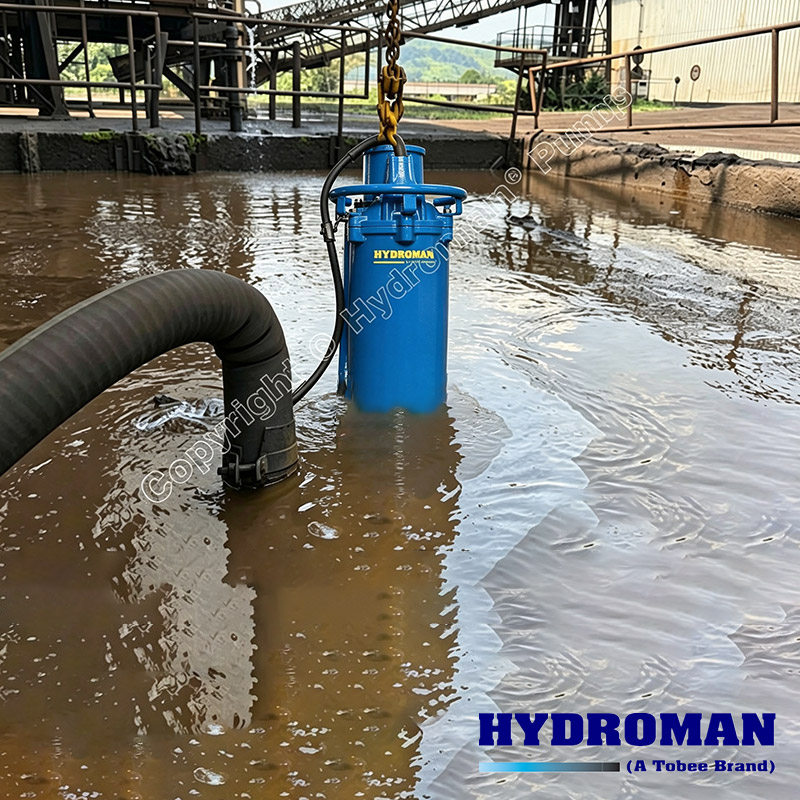
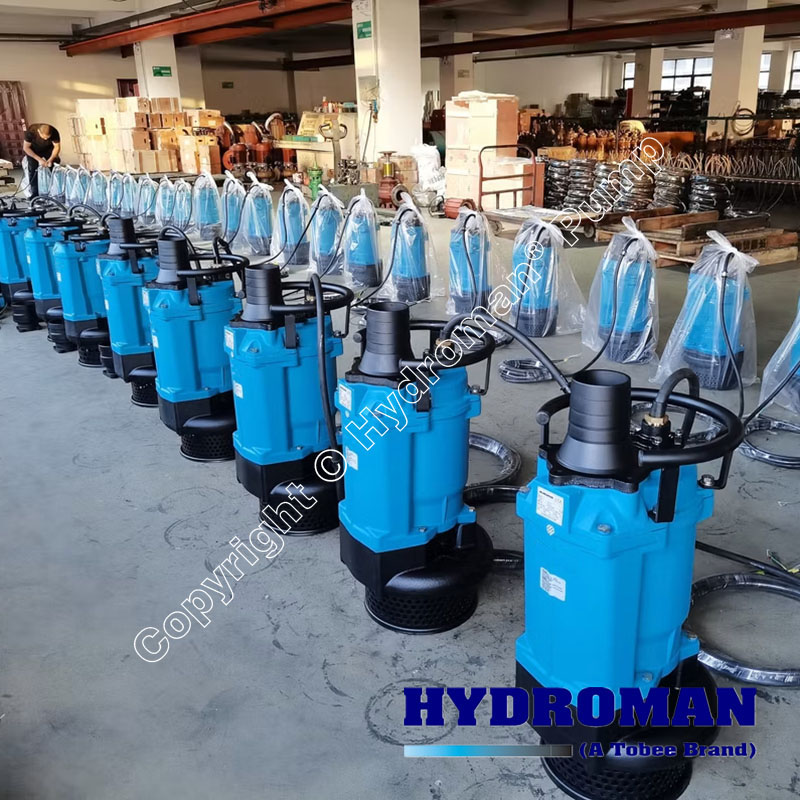
A submersible wastewater pump sits directly in the liquid, usually in a wet well or sump, and pushes it up the discharge pipe. Because the pump is already flooded, there is no suction line to prime. This is the default choice for sewage lift stations, drainage, and many treatment plant duties. If you are comparing an industrial submersible water pump with a surface unit, think about footprint, noise, and depth: submersibles take up almost no floor space and run quietly, and a high head submersible pump can lift effluent to a much higher discharge point than most people expect. Hydroman Pump submersible models are built with sealed motors and solids-passing hydraulics for exactly this kind of continuous duty. |  |
 | Centrifugal Wastewater Pumps
A centrifugal water pump spins liquid outward with an impeller, converting rotational energy into flow and pressure. In wastewater service, you will find them in dry-pit stations, process circulation, and transfer duties where continuous flow matters. Their performance follows a curve of flow against head, and the pump runs best near its best efficiency point. Operate far from it and you pay in vibration, heat, and early wear. |
Positive Displacement Pumps
Positive displacement designs (progressive cavity, diaphragm, piston, lobe) deliver a fixed volume per cycle regardless of pressure. They shine on thick, viscous, or concentrated sludge where a centrifugal pump would lose efficiency, and where accurate metering matters, for example when feeding a dewatering press. Their trade-off is a lower tolerance for large solids and more wear-prone internals, so viscosity, solids content, and pressure need to be reviewed together. | 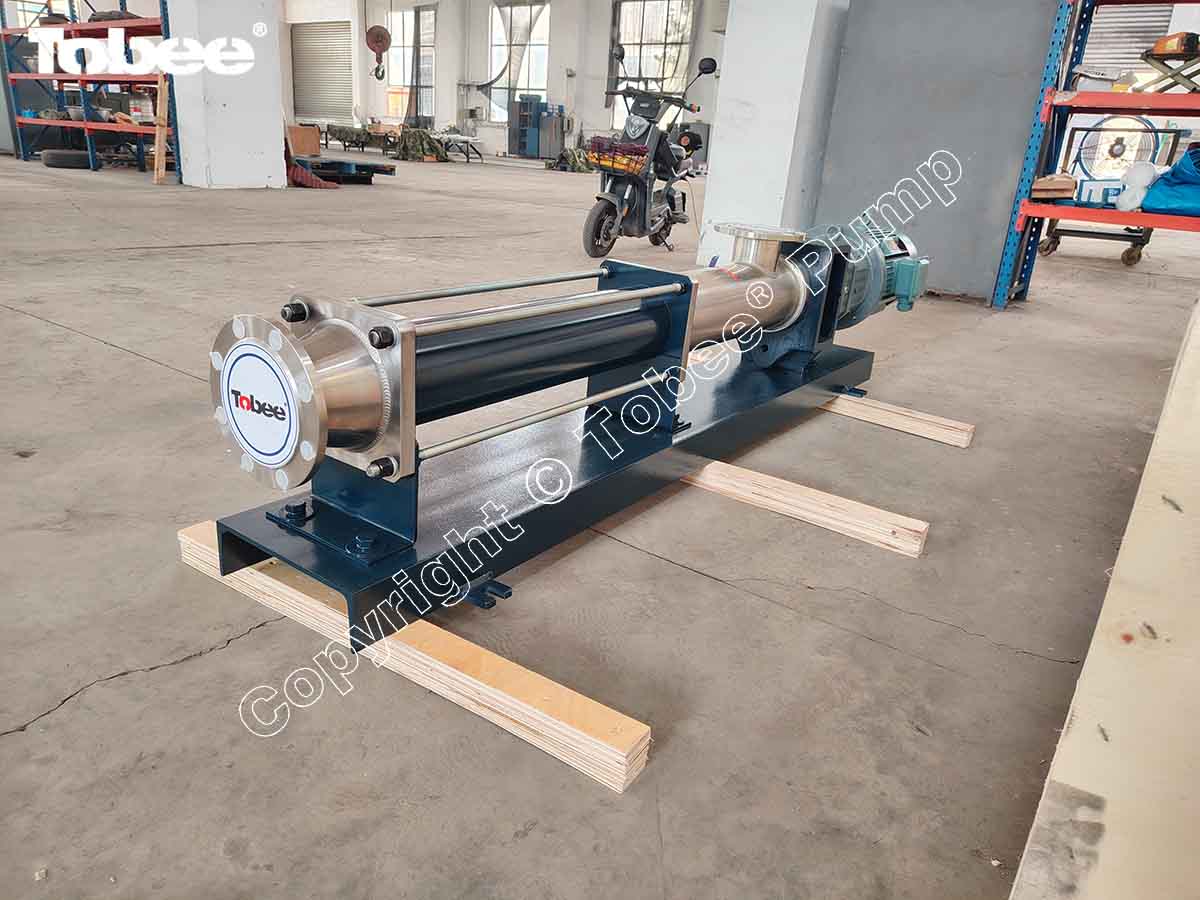 |
 | Grinder and Cutter Pumps
Grinder pumps shred solids and fibers before pumping, which allows the use of small-diameter pressure sewer lines (often 32–50 mm). They are common in residential pressure sewer systems and difficult-terrain collection. They are not a cure-all: cutting systems add wear, and in a large lift station with proper screening, a free-passage pump is usually cheaper to run. |
Self-Priming Wastewater Pumps
A self-priming pump can evacuate air from the suction line and start itself, as long as the casing holds liquid. They suit temporary bypass pumping, accessible dry-installed stations, and drainage jobs where you want the pump above ground. Mind the suction lift limit (usually well below the theoretical 10 m, and often 5–7 m in practice), and the priming time at the start of each cycle. |  |
 | Sludge and Slurry Pumps for Specialized Wastewater Duties
Once solids concentration climbs, a standard sewage pump hits its limit. Thickened sludge, grit slurry, and abrasive mine water call for wastewater sludge pumps or slurry-capable designs with thicker walls, wear-resistant alloys, and larger clearances. This is a core area for Hydroman Pump: our slurry-rated hydraulics and high-chrome options are designed for abrasion that would eat a conventional sewage pump alive. |
| Pump type | Best for | Typical solids handling | Watch out for |
|---|---|---|---|
| Submersible (non-clog) | Lift stations, sumps, drainage | Often 50–100 mm free passage | Seal condition, cooling, lifting access |
| Dry-pit centrifugal | Plant transfer, continuous flow | Depends on impeller; 50–100 mm for non-clog | Needs dry room and suction design |
| Positive displacement | Thick sludge, metered feed | Limited particle size | Wear on stators/diaphragms |
| Grinder / cutter | Pressure sewers, rag-heavy lines | Solids shredded to small pieces | Cutter wear, higher power per flow |
| Self-priming | Bypass, accessible stations | Moderate | Suction lift, priming time |
| Sludge / slurry | Grit, abrasive or dense solids | High solids concentration | Material selection, wear parts |
Advantages and Limitations of Submersible Wastewater Pumps
Advantages
The first benefit is space. Because the pump lives in the wet well, you avoid a separate pump house, and the liquid itself cools the motor. There is no suction-lift priming to worry about during normal submerged operation, and the installation is quiet. For a sewage water pump or an electric sump pump in a basement or small lift station, that simplicity is hard to beat. Well-designed units are also efficient at moving collected wastewater with modest civil works.
Limitations
The flip side: service means lifting. Without a guide-rail system and a hoist, pulling a heavy pump out of a deep well is slow and risky. Seal failure lets moisture into the motor, and a flooded motor is usually a costly repair. Cooling depends on the pump staying sufficiently submerged, and highly abrasive or corrosive liquid may demand special materials and hydraulics.
Installation and Operating Checklist
Before you start up a submersible, confirm the minimum liquid level the manufacturer specifies, so the motor stays cooled. Size the discharge pipe so that flow velocity stays above about 0.6–0.9 m/s (2–3 ft/s) to keep solids moving, but below roughly 3 m/s to limit friction and wear. Fit a guide rail and lifting chain, set level controls so the pump never runs dry, and use overload, leakage, and thermal protection. Also respect the maximum starts per hour in the datasheet; many manufacturers allow around 10–15 for mid-size motors, and short-cycling is a classic cause of premature failure.
Features to Consider When Choosing a Wastewater Pump
Flow Rate and Total Dynamic Head
Start with capacity: how much arrives at peak, not on an average day? Then calculate total dynamic head (TDH), which is the static lift plus friction losses in pipes, fittings, and valves, plus velocity head. Overlay that system curve on the pump curve, and your duty point should sit close to the pump's best efficiency point. A pump that is oversized "to be safe" will often run off-curve, waste energy, and wear faster.
Solids Handling Capacity and Clogging Resistance
Ask for the largest expected solid, the amount of fiber, and the solids concentration. Residential and commercial sewage pumps are commonly rated to pass spheres of 50 mm (2 in) or more, and municipal units go larger. Decide whether you will screen upstream, cut solids with a grinder, or pass them through a free-flow impeller. Each approach works, but mixing them up is how you end up with ragged pumps.
Material Compatibility and Wear Resistance
Materials should match the fluid, not just the brochure. Check pH, chloride content, temperature, and abrasive solids in the real wastewater sample.
| Material | Strengths | Typical use |
|---|---|---|
| Cast iron / ductile iron | Economical, strong, good for neutral sewage | Municipal sewage, drainage |
| Stainless steel 304 / 316 | Corrosion resistance, hygiene | Food, chemical, coastal effluent |
| Duplex stainless | High strength plus chloride resistance | Aggressive industrial effluent |
| High-chrome white iron | Excellent abrasion resistance | Grit, mining slurry, sand-laden water |
| Rubber / polyurethane lining | Impact and fine-particle abrasion resistance | Fine abrasive slurries |
Energy Efficiency and Operating Costs
Judge efficiency at your duty point, not on the motor nameplate. According to the Hydraulic Institute and Europump life-cycle cost guidance, energy often makes up 40% or more of a pump's total cost of ownership for medium-sized pumps in continuous service, while the purchase price is usually a small slice. A modest efficiency gain, a premium-efficiency motor (IE3 or better), or a VFD on a variable-flow station can pay for itself quickly.
Installation Conditions and Power Supply
Check available depth, access for lifting gear, voltage, frequency, and the starting method (direct on line, soft starter, or VFD). Specify an ingress protection of IP68 for submerged motors, and confirm any explosion-proof requirements for hazardous areas.
Maintenance Requirements and Control Options
Ask how long a seal swap takes, whether impellers can be cleared without full disassembly, and whether spare parts are available in your region. Then look at control: float switches work for a simple electric sump pump, while ultrasonic or pressure level sensors, alarm panels, and remote telemetry suit larger stations.
Common Applications of Wastewater Pumps
Municipal Wastewater Treatment Plants
Municipal plants rely on pumps from the headworks to the outfall: raw sewage lift, primary sludge transfer, return activated sludge, and final effluent. Dependability under changing inflow is the key, because storm events can multiply flows several times over dry-weather rates. A submersible pump for sewage treatment plant duty must combine non-clog hydraulics with a rugged seal system.
Industrial Wastewater Treatment and Effluent Management
Factories, chemical plants, food processors, and textile mills produce effluents with very different personalities: hot, acidic, oily, fibrous, or loaded with fines. This is where an industrial submersible pump needs to be specified against the real fluid, not the average sewage assumption. Process transfer, equalization tanks, neutralization, and sludge handling all create different pumping needs inside the same plant.
Commercial Buildings and Residential Sewage Systems
Basements, restaurants, hotels, and any site below the sewer connection need a way to lift waste upward. A commercial waste water pump or a grinder unit moves toilet and kitchen waste, while an electric sump pump handles groundwater and drainage. Keep the two apart: sump and clean-water drainage pumps are not built for sewage and will clog or fail quickly if used that way.
Mining, Construction, and Heavy-Duty Dewatering
Pits, tunnels, and foundations collect sandy, silty water that wears out ordinary pumps. A standard water removal pump may survive a few days; a slurry-capable design with hardened wetted parts survives seasons. Look for abrasion-resistant alloys, generous solids passage, and a robust bearing arrangement.
Agriculture and Environmental Water Management
Livestock operations, aquaculture, irrigation return flows, and stormwater storage all demand pumps that tolerate debris and variable water quality. Fibrous material, algae, and sediment shape the right choice more than any headline power rating.
 |  |
How Wastewater Pumps Support the Wastewater Treatment Process
It helps to follow the water through the plant. At the inlet, large submersible or dry-pit pumps lift raw sewage from the wet well into the headworks, and level control smooths the changing inflow. During primary and secondary treatment, smaller pumps circulate mixed liquor, recycle flow, and return activated sludge; because each stream has different solids content, a one-pump-fits-all approach does not work. Finally, sludge and effluent need different tools: thick sludge often calls for positive displacement or sludge-rated centrifugal pumps, while treated effluent can usually be moved with high-efficiency, low-solids pumps toward its approved discharge point.
Wastewater Pump Maintenance and Troubleshooting
Routine Inspection and Preventive Maintenance
A simple routine catches most problems early. Check seals and oil condition, cable insulation and glands, impeller clearance, and discharge piping. Track motor current, vibration, noise, and temperature, and compare them to baseline readings from commissioning. Set intervals according to duty: a pump at a rag-heavy lift station needs more frequent attention than one in a screened, clean-ish process line. Always follow the manufacturer's service schedule as your starting point.
Common Wastewater Pump Problems
| Symptom | Likely causes | First thing to check |
|---|---|---|
| Low flow or head | Partial blockage, worn impeller, wrong rotation, system change | Rotation direction, discharge valve, impeller clearance |
| Frequent clogging | Wrong impeller type, fibrous load, low flow velocity | Solids data vs. impeller passage, screening upstream |
| Overheating / tripping | Overload, running dry, poor cooling, voltage imbalance | Liquid level, motor current, thermal sensor |
| Leakage, vibration, noise | Seal wear, bearing damage, cavitation, misalignment | Oil chamber condition, operating point on curve |
Ways to Reduce Downtime and Operating Costs
Match the pump to the actual wastewater from day one. Watch operating data, because a slow drift in current or flow tells you something is changing long before the pump stops. Keep critical spares on the shelf (seals, wear rings, an impeller), keep service records, and revisit the duty point whenever process demand changes.
Emerging Trends in Wastewater Pump Technology
Smart Monitoring and Predictive Maintenance
Embedded sensors now track temperature, vibration, insulation resistance, and run hours, and send the data to a dashboard. That turns maintenance from a calendar chore into a condition-based decision: a rising vibration trend can flag bearing wear before a failure shuts down a station.
Energy-Efficient Pumping Systems
High-efficiency motors, better hydraulic profiles, and VFD control continue to lower energy per cubic meter pumped. The biggest savings, though, come from looking at the whole system: right-sized pumps, sensible pipe diameters, and well-set level controls often beat swapping to a bigger motor.
Advanced Materials and Improved Solids Handling
Wear-resistant alloys, coatings, and improved impeller geometries extend service life and cut clogging, particularly in rag-heavy sewage and abrasive industrial streams.
 |  |
Frequently Asked Questions About Wastewater Pumps
What is the difference between a wastewater pump and a sewage pump?
The terms overlap. "Wastewater pump" is the broad category covering any pump that handles dirty water, effluent, or sludge. A sewage pump is a specific type designed for raw sewage with solids and fibers. What really distinguishes models is their solids-handling rating and intended service.
Which type of pump is best for industrial wastewater?
It depends on flow, head, solids, viscosity, chemistry, and installation conditions. A submersible non-clog pump works for many plants, while thick sludge or abrasive streams may need a positive displacement or slurry-rated pump. Send us a fluid sample description and we can narrow it down quickly.
Can a submersible water pump handle wastewater?
Only if the manufacturer rates it for it. A clean-water submersible has tight clearances and will clog or wear out on sewage or solids-laden water. Choose a pump labeled and tested for wastewater duty.
How do I select the right wastewater pump capacity?
Work from peak flow, calculated TDH, and system losses, then choose a pump whose duty point sits near its best efficiency point. Allow some margin, but avoid heavy oversizing.
How can I reduce wastewater pump clogging?
Use an impeller with enough solids passage, screen out large debris where practical, keep flow velocity high enough to move solids, and maintain the pump on a regular schedule.
How often should a wastewater pump be maintained?
There is no single interval. Frequency depends on run hours, what is in the liquid, the installation, and the manufacturer's guidance. Many operators inspect lift-station pumps several times a year and do a full service annually, adjusting upward for harsh duty.
Conclusion
The right pump comes from understanding your wastewater, not from picking a product name. Pump type, hydraulic performance, solids handling, materials, and installation conditions all work together, and getting one wrong can undo the rest. Look at the whole system (flow, head, solids, chemistry, energy, and maintenance access) and the pump choice becomes much clearer.
If you are planning a waste water treatment project, upgrading a lift station, or struggling with a pump that keeps clogging, the Hydroman Pump team can help. As a manufacturer, we can recommend a submersible wastewater pump or sludge/slurry solution built around your duty point, share technical specifications and performance curves, and prepare a quotation.
Contact Hydroman Pump with your flow, head, and fluid details, and we will get back to you with an application-specific recommendation.
 Sara Liang